


Medical Hair Encyclopedia
Dermatological pathologies and evidence-based clinical guidelines at international standards.
CLINICAL GUIDELINE & PATHOLOGY
Lichen Planopilaris (LPP) Diagnosis and Treatment Guide
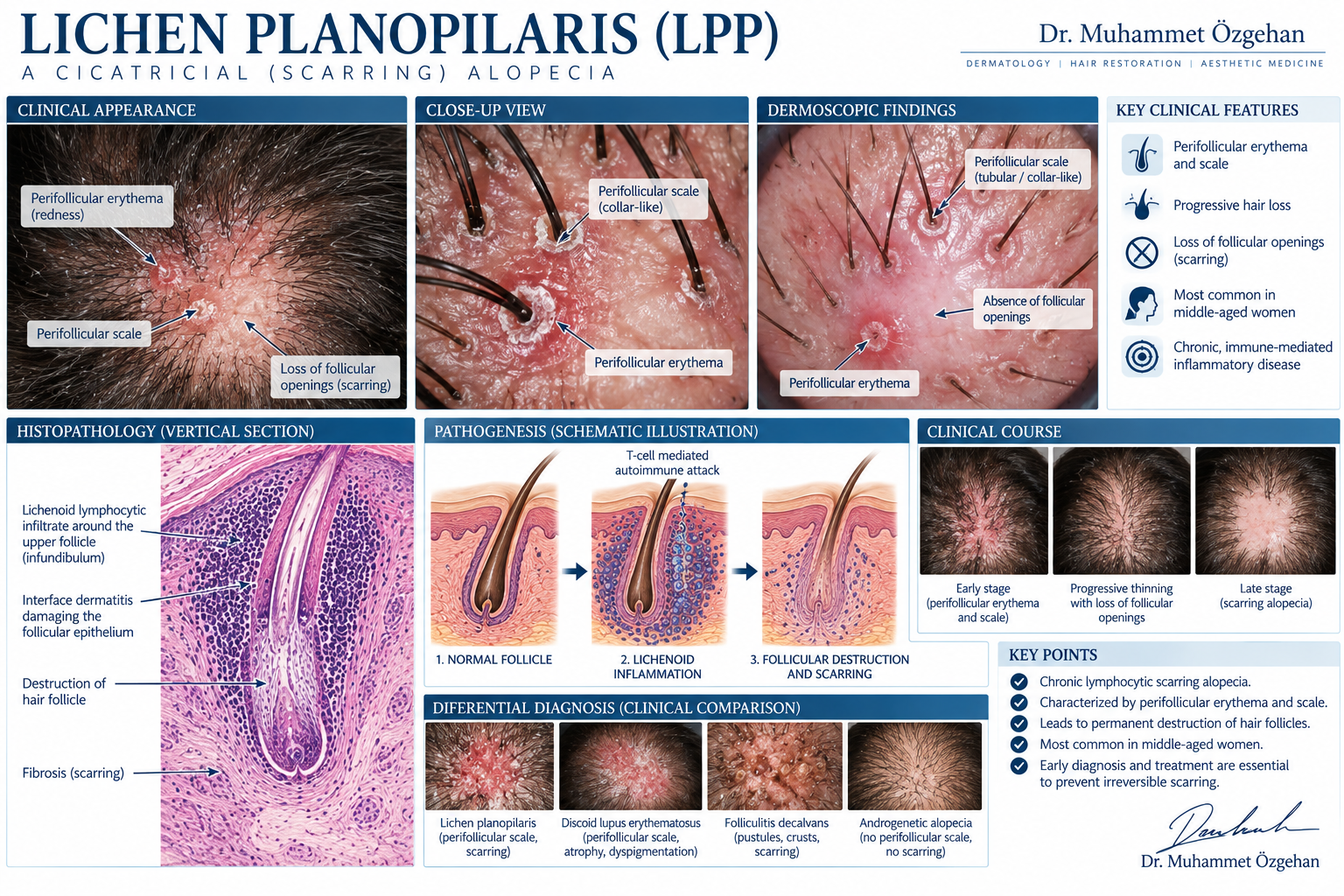
📌 Patient Information Section: What Does This Condition Mean?
Lichen planopilaris (LPP) is a type of permanent (scarring) hair loss characterized by inflammation and eventual destruction of hair follicles targeted by immune system cells. If not treated early, hair will never regrow in the affected areas.
- What Are the Symptoms?: It begins with itching, stinging, burning sensation, tenderness, and redness in the scalp. Over time, smooth and shiny scarred areas develop in these regions where hair follicles are completely lost.
- What Should You Do?: In cases of hair loss accompanied by severe itching and burning, it is vital to consult a specialist physician without delay.
🩺 Clinical & Medical Guide for Physicians
- Etiology and Pathophysiology: It is the most common form of primary lymphocytic cicatricial alopecias. The target is the stem cells in the infundibulum and isthmus regions.
- Diagnostic Criteria: Follicular hyperkeratosis, perifollicular erythema, and violaceous rings. A positive pull test at active borders.
- Histopathological Diagnosis (Punch Biopsy):
- Technique: A 4 mm punch biopsy should be taken from the active lesion border (where perifollicular erythema is most intense); the material should be examined in transverse (horizontal) sections.
- Pathology: Dense lymphocytic infiltrate around the isthmus (lichenoid infiltration), loss of sebaceous glands, and perifollicular fibrosis.
- Current Treatment Protocols: Topical/intralesional corticosteroids; systemically hydroxychloroquine, cyclosporine, or methotrexate. Additionally, expertise and treatment approaches can be reviewed for clinical and surgical evaluations.
Scientific References and Bibliography
- Kłosowicz A, Englert K, Pełka K, Pastuszczak M, Pastuszczak A. Autoimmunity in lichen planopilaris patients. Pol Merkur Lekarski. 2019 Jan 28;46(271):32-35. PMID: 30810113. PubMed Link
- Poblet E, Jiménez F, Pascual A, Piqué E. Frontal fibrosing alopecia versus lichen planopilaris: a clinicopathological study. Int J Dermatol. 2006 Apr;45(4):375-80. doi: 10.1111/j.1365-4632.2006.02507.x. PMID: 16650161. PubMed Link
- Orlando G, Rapparini L, Bruni F. Lichen Planopilaris Trichoscopy in Caucasian Scalp: A Review. Skin Appendage Disord. 2024 Dec;10(6):459-462. doi: 10.1159/000539848. Epub 2024 Jul 11. PMID: 39659655; PMCID: PMC11627541. PubMed Link
- Sehgal VN, Bajaj P. Lichen planopilaris. Int J Dermatol. 2001 Aug;40(8):516-7. doi: 10.1046/j.1365-4362.2001.01065.x. PMID: 11703523. PubMed Link