Medical Hair Encyclopedia
Dermatological pathologies and evidence-based clinical guidelines at international standards.
Alopecia Areata Diagnosis and Treatment Guide
Prepared by: Dr. Muhammet Özgehan | Turkish Hair and Scalp Diseases Association
This guide has been compiled by Dr. Muhammet Özgehan in light of current literature.

📌 Patient Information Section: What Does This Condition Mean?
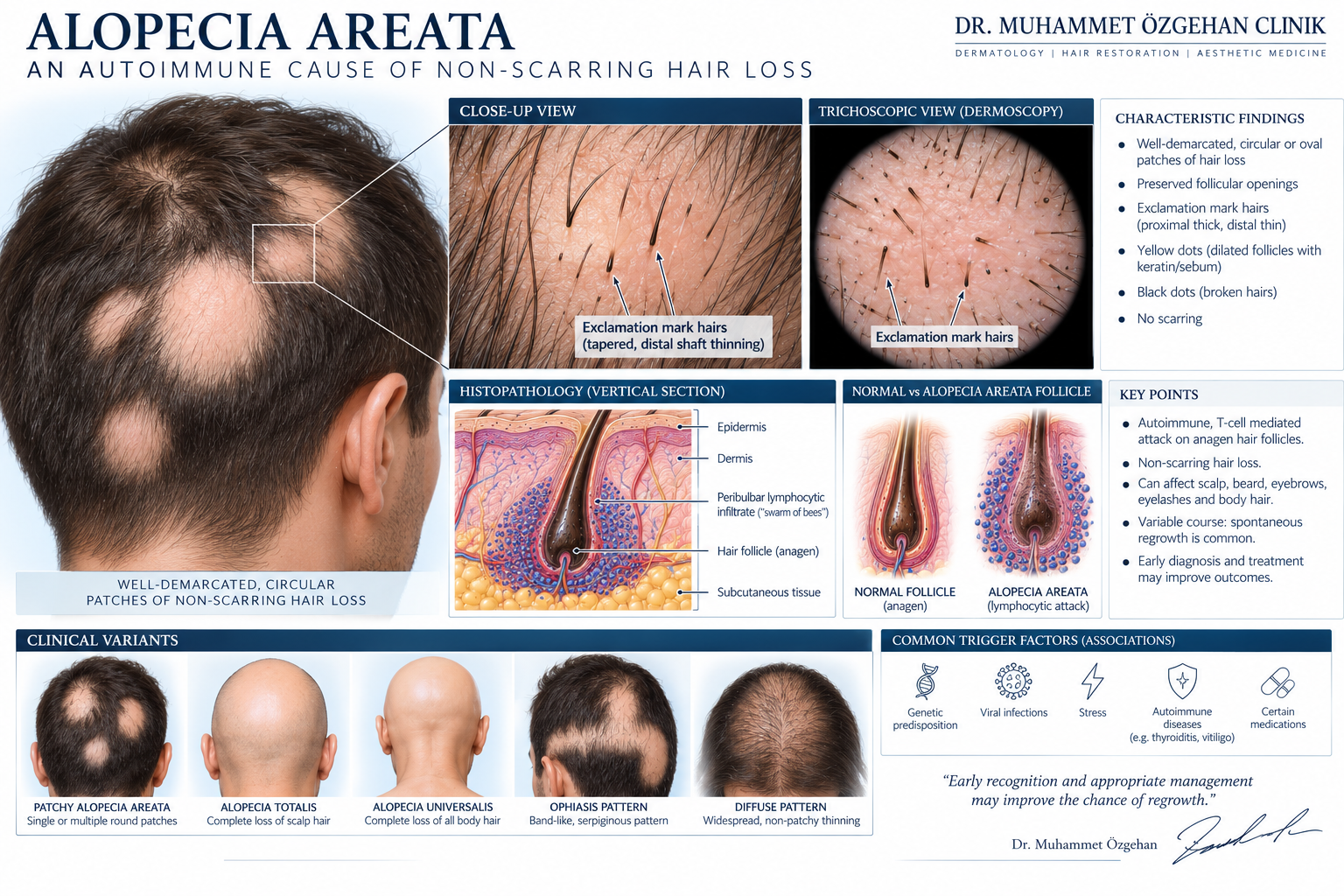
Alopecia areata, commonly known as patchy hair loss, is an inflammatory condition characterized by sudden, coin-sized, round areas of hair loss with well-defined borders on the scalp, beard, or other hairy parts of the body.
- Is it Contagious?: It is absolutely not a contagious disease; it is certainly not a type of fungus or infection.
- What Causes It?: It develops when the regulatory cells of the body's immune system (T lymphocytes) mistakenly target hair follicles that they should not normally perceive as foreign (autoimmune mechanism). Severe stress or certain triggers can exacerbate an attack.
- Is it Curable?: Hair follicles do not die; they are merely dormant under immune system suppression. With proper and patient treatment, hair regrowth is possible.
🩺 Clinical & Medical Guide for Physicians
- Diagnostic Criteria and Clinical Findings: Clinically, sudden-onset, patchy areas of hair loss are observed. The presence of easily extractable, thinned-at-the-base "exclamation mark" hairs around the lesions is pathognomonic for diagnosis.
- Dermoscopy (Trichoscopy) Findings: Yellow dots, black dots (broken hair remnants), short vellus hairs, and pigtail hair remnants.
- Associated Conditions: The patient should be screened for the presence of other autoimmune diseases such as thyroid diseases, atopy, or vitiligo.
- Current Treatment Protocols:
- Local Treatments: Intralesional Corticosteroid Injections applied directly into the lesion for localized hair loss.
- Topical Immunotherapy: Controlled immunomodulation with topical sensitizers in resistant cases.
- Systemic & Modern Treatments: Molecularly targeted JAK inhibitors and short-term systemic corticosteroid courses for widespread and resistant cases. Additionally, specialized expertise and treatment approaches should be considered for surgical or clinical evaluations.
Scientific References and Bibliography
- Dahabreh D, Jung S, Renert-Yuval Y, Bar J, Del Duca E, Guttman-Yassky E. Alopecia Areata: Current Treatments and New Directions. Am J Clin Dermatol. 2023 Nov;24(6):895-912. doi: 10.1007/s40257-023-00808-1. Epub 2023 Aug 22. PMID: 37606849. PubMed Link
- Sibbald C. Alopecia Areata: An Updated Review for 2023. J Cutan Med Surg. 2023 May-Jun;27(3):241-259. doi: 10.1177/12034754231168839. PMID: 37340563; PMCID: PMC10291119. PubMed Link
- Gaurav A, Eang B, Mostaghimi A. Alopecia Areata. JAMA Dermatol. 2024 Mar 1;160(3):372. doi: 10.1001/jamadermatol.2023.4661. PMID: 38265795. PubMed Link
- King BA, Craiglow BG. Janus kinase inhibitors for alopecia areata. J Am Acad Dermatol. 2023 Aug;89(2S):S29-S32. doi: 10.1016/j.jaad.2023.05.049. PMID: 37591562. PubMed Link
Alopecia Areata Frequently Asked Questions
Questions about alopecia areata diagnosis, treatment, JAK inhibitors, and modern approaches, with the expertise of Dr. Muhammet Özgehan's Clinic.
Alopecia Areata is an autoimmune hair loss disorder that develops when the immune system mistakenly targets hair follicles. Dr. Muhammet Özgehan, when evaluating alopecia areata patients at his clinic, meticulously analyzes the extent of hair loss, stress factors, and genetic predisposition to determine a personalized roadmap.
In mild and single-patch cases, the immune system may rebalance over time, and hair can regrow spontaneously within 6-12 months. However, Dr. Muhammet Özgehan emphasizes that in cases of widespread or frequently recurring hair loss (Alopecia Totalis/Universalis), the spontaneous recovery rate is low, and early professional clinical follow-up is essential to prevent permanent dormancy of the follicles.
In Alopecia Areata, hair follicles do not die; rather, they enter a dormant state due to immune suppression. Dr. Muhammet Özgehan stresses that with appropriate medical protocols and modern treatment combinations, these dormant follicles can be reactivated, allowing patients to regain their natural hair.
One of the greatest revolutions in modern medicine for alopecia areata treatment, JAK Inhibitors block the signaling pathways that cause the immune system to attack hair follicles. Dr. Muhammet Özgehan safely manages these modern, FDA-approved JAK inhibitor treatments for resistant and widespread cases that have not responded to other traditional therapies, considering the patient's overall health status.
At our clinic, treatment is planned with a multidisciplinary approach based on the stage of hair loss and the patient's immune profile. The main treatment methods applied by Dr. Muhammet Özgehan include:
- JAK Inhibitor Treatments: Modern targeted agents that regulate the immune system.
- Corticosteroid Treatments: Regional micro-injections and topical applications.
- PRP and Mesotherapy Courses: Supportive sessions applied to nourish hair follicles and accelerate cellular healing.
- Topical Immunotherapy: Special solutions that locally modulate the immune response on the scalp.
Hair transplantation is not performed for Alopecia Areata patients in the active hair loss phase, as the transplanted follicles would also be targeted by the immune system. Dr. Muhammet Özgehan states that hair transplantation may be planned in selected cases, only after a detailed clinical examination, in rare situations where the disease has entered complete remission and remained stable for a long period.
Alopecia Areata is absolutely not a contagious infection. Dr. Muhammet Özgehan specifically explains to his patients that it is an autoimmune condition entirely related to the body's own immune mechanism and will not be transmitted to others through social contact.