


Medical Hair Encyclopedia
Dermatological pathologies and evidence-based clinical guidelines at international standards.
CLINICAL GUIDELINE & PATHOLOGY
Scalp Psoriasis – Diagnosis and Treatment Guide
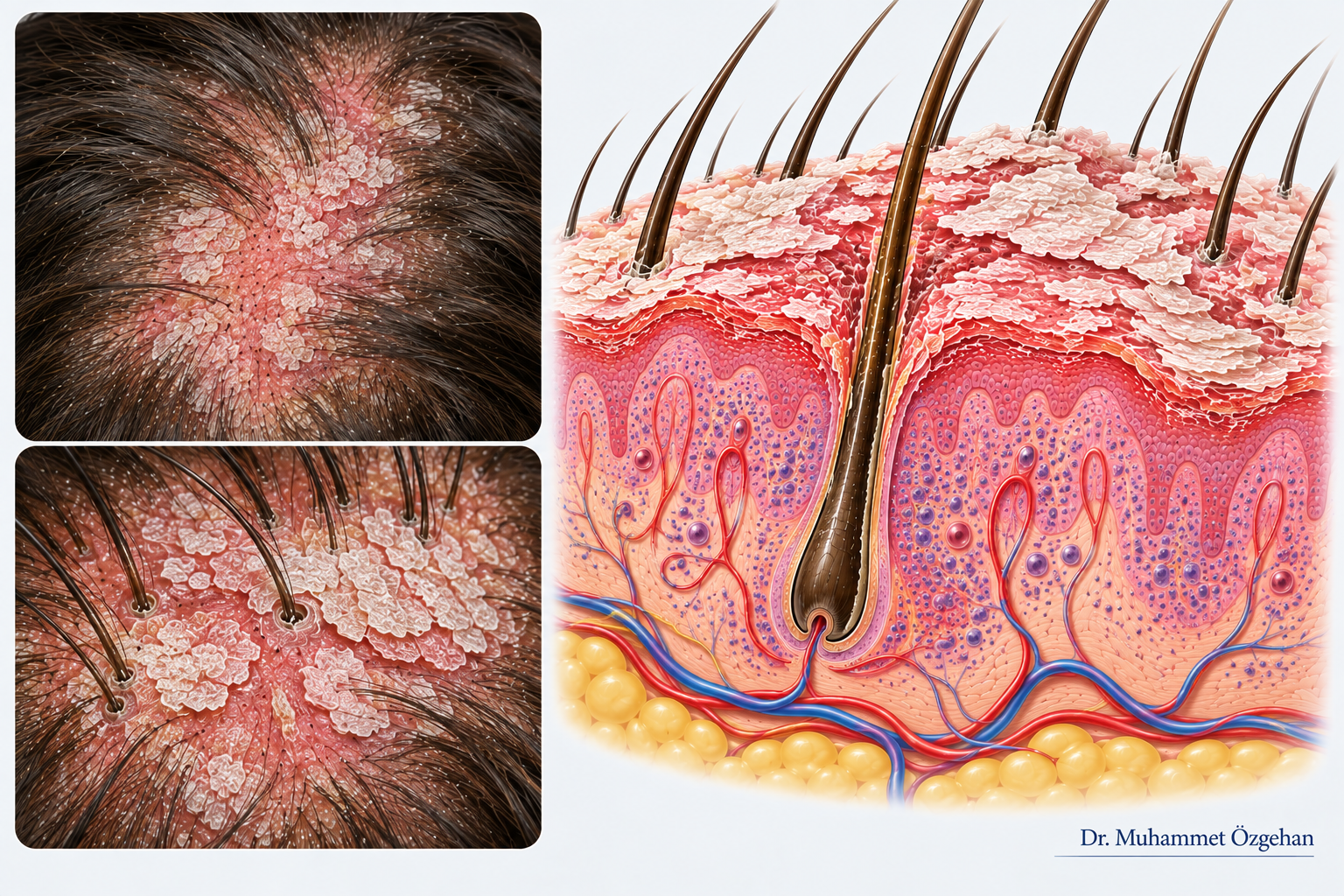
📌 Patient Information Section: What Does This Condition Mean?
Scalp psoriasis is a chronic form of psoriasis that occurs when the body's immune system causes skin cells to multiply much faster than normal. It is not contagious; however, it develops on a background of genetic predisposition.
- How Does It Differ from Seborrheic Dermatitis?: While seborrheic dermatitis typically presents with oily, yellowish scales and mild redness, psoriasis on the scalp forms thick, layered, silvery-white scales and sharply demarcated red plaques. It can extend beyond the hairline to the forehead or neck.
- Does Hair Fall Out?: Psoriasis itself does not directly cause permanent (scarring) hair loss; however, attempting to remove the thick scales or severe scratching can lead to temporary hair breakage and shedding.
- What Should Be Done?: Ordinary dandruff shampoos cannot dissolve psoriatic plaques. Special keratolytic agents and medical treatments should be used under the supervision of a specialist physician.
🩺 Clinical & Medical Guide for Physicians
- Etiology and Pathophysiology: An autoimmune condition characterized by accelerated epidermal cell turnover (hyperproliferation) and parakeratosis, triggered by a T-cell-mediated immune response.
- Diagnostic Criteria and Clinical Findings: Sharply demarcated erythematous plaques with silvery-white, thick scales on the scalp. Typical localization behind the ears and at the frontal hairline (corona psoriatica). Auspitz sign (pinpoint bleeding foci observed when scales are lifted).
- Dermoscopy (Trichoscopy) Findings: Dilated loop capillaries that are tortuous, punctiform, or resemble hairpins, homogeneously distributed on a light pink background. Yellowish-white scale structures (dry in nature, unlike the oily dandruff in seborrheic dermatitis).
- Histopathological Diagnosis (Punch Biopsy):
- Biopsy Indication and Technique: A 4 mm punch biopsy is taken from atypical lesions where differential diagnosis with seborrheic dermatitis or lichen planopilaris is challenging. Examination is performed with vertical sections.
- Pathological Findings: Marked acanthosis in the epidermis, regular elongation of rete ridges, retention of nuclei in the stratum corneum (parakeratosis), Monro microabscesses (neutrophil accumulations within the stratum corneum), and increased tortuous, dilated capillaries in the papillary dermis.
- Current Treatment Protocols:
- Topical Keratolytics and Anti-inflammatories: Solutions containing salicylic acid or urea to soften and remove thick scales. Potent topical corticosteroid lotions or calcipotriol (vitamin D analog) combinations during acute phases.
- Shampoos and Phototherapy: Tar, zinc pyrithione, or salicylic acid-based medicated shampoos. Targeted UV phototherapy combs for resistant scalp lesions.
- Systemic Treatments: For widespread cases resistant to topical treatments, systemic retinoids, methotrexate, or modern biological agents (biologics) are planned under specialist supervision. Additionally, expertise and treatment approaches can be reviewed for clinical and surgical evaluations.
Scientific References and Bibliography
- Kircik LH, Kumar S. Scalp psoriasis. J Drugs Dermatol. 2010 Aug;9(8 Suppl ODAC Conf Pt 2):s101-5. PMID: 20715392. PubMed Link
- Zhang L, Su Y, Shucheng H, Wang L, Jiang X. Systemic therapy in treating palmoplantar and scalp psoriasis: A systematic review and network meta-analysis. J Am Acad Dermatol. 2024 Mar;90(3):646-648. doi: 10.1016/j.jaad.2023.10.064. Epub 2023 Nov 15. PMID: 37977294. PubMed Link
- Ghafoor R, Patil A, Yamauchi P, Weinberg J, Kircik L, Grabbe S, Goldust M. Treatment of Scalp Psoriasis. J Drugs Dermatol. 2022 Aug 1;21(8):833-837. doi: 10.36849/JDD.6498. PMID: 35946971. PubMed Link