


Medical Hair Encyclopedia
Dermatological pathologies and evidence-based clinical guidelines at international standards.
CLINICAL GUIDELINE & PATHOLOGY
Scalp Sarcoidosis – Diagnosis and Treatment Guide
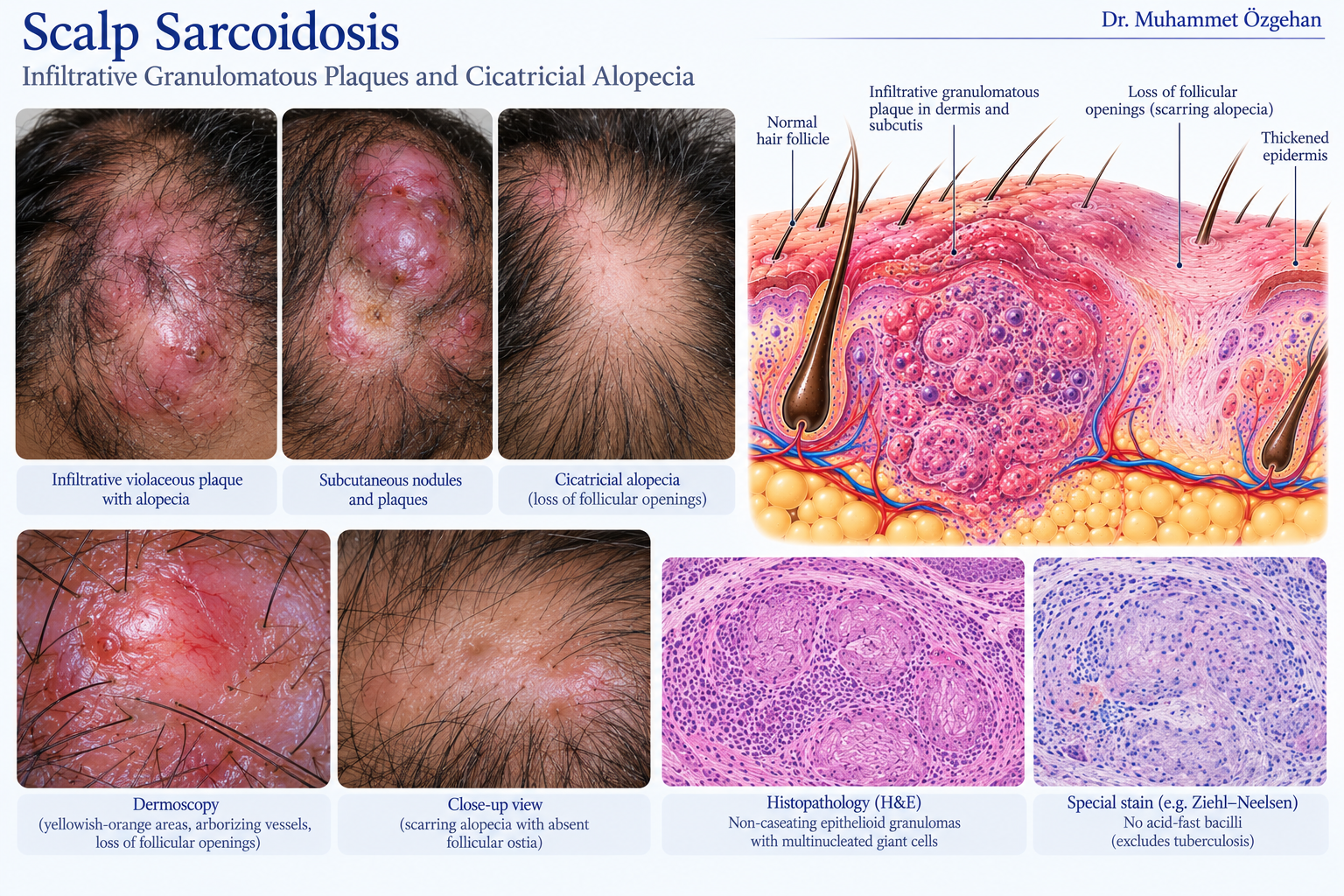
📌 Patient Information Section: What Does This Condition Mean?
Sarcoidosis is a systemic disease characterized by the accumulation of the body's immune cells in organs, forming inflammatory nodules called "granulomas." Although it usually affects the lungs, it can rarely settle in the scalp, leading to permanent hair loss.
- Appearance on the Scalp: It manifests as red-purple firm nodules, plaques, or diffuse indurated areas on the scalp. In these regions, hair follicles are permanently destroyed, and cicatricial (permanent) alopecia develops.
- Other Findings: Systemic symptoms such as cough, shortness of breath, joint pain, or ocular findings may accompany the condition.
- What to Do?: These scalp lesions may be the first harbinger of systemic sarcoidosis. A biopsy is essential for a definitive diagnosis, and a full-body screening (lungs, etc.) should be performed.
🩺 Clinical & Medical Guide for Physicians
- Etiology and Pathophysiology: An exaggerated T-cell and macrophage response to environmental antigens in genetically predisposed individuals, the exact cause of which is unknown. Destruction of hair follicles and the dermis by non-caseating granulomas.
- Diagnostic Criteria and Clinical Findings: Erythematous-violaceous, firm (infiltrative) plaques and nodules upon palpation, and areas of cicatricial alopecia on the scalp. Presence or absence of systemic involvement findings.
- Dermoscopy (Trichoscopy) Findings: Violaceous/yellowish-pink homogeneous background, loss of follicular ostia, branching fine telangiectasias, and cicatricial white reticular areas.
- Histopathological Diagnosis (Punch Biopsy):
- Biopsy Indication: A deep 4 mm punch biopsy is taken from infiltrative lesions of unknown cause in patients presenting with cicatricial alopecia.
- Pathology: "Naked granulomas" (naked granulomas) consisting of epithelioid cells and multinucleated giant cells in the dermis, without caseating necrosis.
- Current Treatment Protocols:
- Systemic and Topical Treatments: Systemic corticosteroids (Prednisolone) in widespread and progressive cases. Hydroxychloroquine, methotrexate, or immunomodulatory/biological agents in corticosteroid-resistant cases. Intralesional triamcinolone acetonide injections for local lesions. Additionally, expertise and treatment approaches can be reviewed for clinical and surgical evaluations.
Scientific References and Bibliography
- Katta R, Nelson B, Chen D, Roenigk H. Sarcoidosis of the scalp: a case series and review of the literature. J Am Acad Dermatol. 2000 Apr;42(4):690-2. PMID: 10727323. PubMed Link
- Charakida A, Teixeira F, Kubba F, Anton A, Schulman D, Cintra ML. A rare manifestation of scalp sarcoidosis. Int J Dermatol. 2023 Jan;62(1):e9-e10. doi: 10.1111/ijd.16329. Epub 2022 Jul 3. PMID: 35781880. PubMed Link
- Sikora M, Obijiofor C, Lo Sicco K, Caplan A. Scarring alopecia from cutaneous sarcoidosis of the scalp. Sarcoidosis Vasc Diffuse Lung Dis. 2024 Mar 26;41(1):e2024018. doi: 10.36141/svdld.v41i1.15660. PMID: 38567553; PMCID: PMC11008329. PubMed Link