Medical Hair Encyclopedia
Dermatological pathologies and evidence-based clinical guidelines at international standards.
Discoid Lupus Erythematosus (DLE) Diagnosis and Treatment Guide
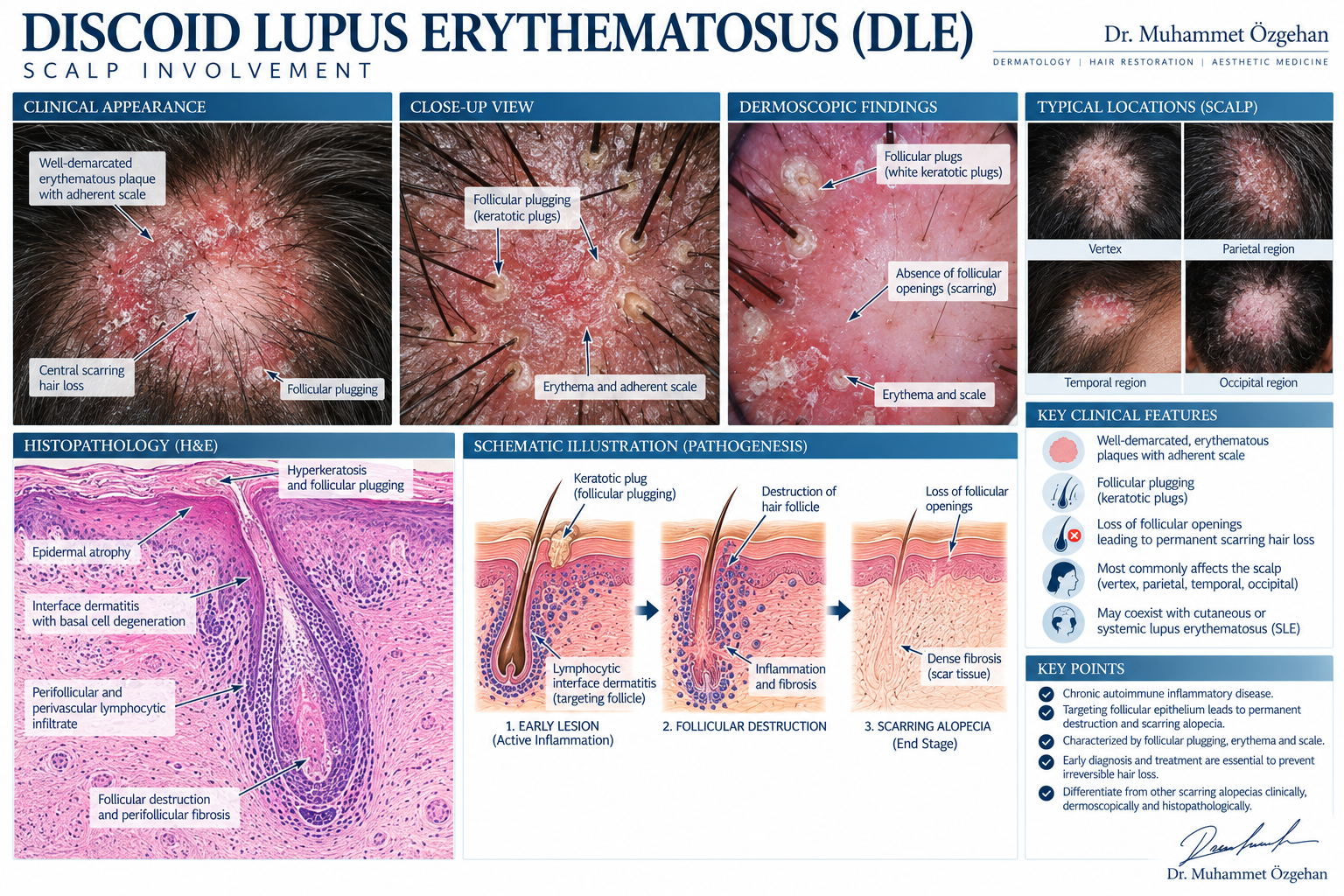
Prepared by: Dr. Muhammet Özgehan | Turkish Hair and Scalp Diseases Association
This guide has been compiled by Dr. Muhammet Özgehan in light of current literature.

📌 Patient Information Section: What Does This Condition Mean?
Discoid Lupus Erythematosus (DLE) is a chronic inflammatory disease where the immune system targets the skin, characterized by sharply demarcated, scaly, erythematous plaques on the scalp and face, which eventually lead to permanent scarring.
- Is it Permanent?: If not treated in the early stage, hair follicles suffer permanent damage, and scarring (permanent baldness) may develop in those areas.
- Sun Sensitivity: Ultraviolet (UV) rays can directly trigger or exacerbate lesions; therefore, sun protection is an integral part of treatment.
🩺 Clinical & Medical Guide for Physicians
- Clinical Criteria: Discoid plaques, follicular plugging (occluded follicular ostia), atrophy, and telangiectasia. Trichoscopy reveals prominent pigment networks and hyperkeratotic plugs.
- Histopathological Diagnosis (Punch Biopsy):
- Technique: A 4 mm punch biopsy specimen taken from the active lesion border should be examined with vertical and horizontal sections.
- Pathology: Epidermal atrophy, vacuolar degeneration in the basal cell layer, dermal perivascular and perifollicular lymphocytic infiltrate with thickened basement membrane.
- Treatment Protocols: Strict sun protection, topical/intralesional corticosteroids. Systemic antimalarial agents (hydroxychloroquine). Additionally, specialized expertise and treatment approaches can be reviewed for clinical and surgical evaluations.
Scientific References and Bibliography
- Concha JSS, Werth VP. Alopecias in lupus erythematosus. Lupus Sci Med. 2018 Oct 25;5(1):e000291. doi: 10.1136/lupus-2018-000291. PMID: 30397497; PMCID: PMC6203010. PubMed Link
- Gowda SK, Errichetti E, Thakur V, Panda M, Dash S, Agarwal A, Sethy M, Ayyanar P, Behera B. Trichoscopic Features of Scalp Discoid Lupus Erythematosus versus Lichen Planopilaris: A Systematic Review. Clin Cosmet Investig Dermatol. 2024 Apr 9;17:805-827. doi: 10.2147/CCID.S460742. PMID: 38616887; PMCID: PMC11015838. PubMed Link
- Żychowska M, Żychowska M. Dermoscopy of discoid lupus erythematosus - a systematic review of the literature. Int J Dermatol. 2021 Jul;60(7):818-828. doi: 10.1111/ijd.15365. Epub 2020 Dec 15. PMID: 33319363. PubMed Link
Discoid Lupus Erythematosus (DLE) and Hair Involvement: Frequently Asked Questions
Insights into scarring alopecia, DLE diagnostic processes, medical approaches, and suitability for hair transplantation, with the expertise of Dr. Muhammet Özgehan Clinic.
Discoid lupus erythematosus (DLE) is a chronic, autoimmune skin disease that primarily affects the scalp, face, and ears, potentially leaving permanent scars. On the scalp, it manifests as round or irregular, scaly, erythematous plaques with central depigmentation (atrophy). Dr. Muhammet Özgehan states that this autoimmune process can target hair follicles, leading to irreversible damage.
Yes, DLE is one of the most significant and noteworthy causes of cicatricial (scarring/permanent) alopecia. In areas where plaques form, hair follicles are replaced by connective tissue (scar); therefore, if not intervened early, hair regrowth in those areas is not possible. Dr. Muhammet Özgehan emphasizes that early diagnosis and rapid suppression of active lesions are vital for preserving existing hair.
The primary goal of treatment is to suppress the autoimmune response, halt inflammation, and prevent the expansion of scar tissue. Current approaches applied at Dr. Muhammet Özgehan's clinic include:
- Dermatological and Systemic Medical Treatments: Physician-prescribed topical/intralesional corticosteroids or systemic antimalarial drug protocols to control inflammation.
- Sun and UV Protection Protocols: Education on protection from sunlight and UV radiation, which trigger DLE lesions.
- Active Lesion Monitoring: Regular trichoscopic and dermatological examinations to monitor whether the disease is active or quiescent (in remission).
Hair transplantation is absolutely contraindicated (not performed) in cases with active DLE lesions or when the disease has not entered remission (quiescent period), as trauma can trigger new lesions. Dr. Muhammet Özgehan states that, however, if the disease has been completely quiescent/inactive for many years, if the tissue scarring is suitable, and after detailed clinical pre-evaluations, surgical options may be considered in very special cases, but the graft survival rate in scarred tissue must be meticulously analyzed.
Managing autoimmune processes requires discipline. Dr. Muhammet Özgehan offers the following recommendations to individuals diagnosed with DLE:
- Using hats or UV protective products to shield the scalp from sunlight.
- Avoiding chemical dyes, harsh perms, or aggressive cosmetic procedures that can irritate the scalp.
- Consulting a dermatologist without delay if there is even the slightest redness, scaling, or increased sensitivity on the scalp.
For Your Questions and Clinic Appointment
For any questions you may have about Discoid Lupus Erythematosus (DLE), scarring hair loss, and treatment planning, or to schedule a personal examination, you can contact Dr. Muhammet Özgehan Clinic immediately.