Dr. Muhammet Özgehan
TR EN DE FR RU AR

Medical Hair Encyclopedia

Dermatological pathologies and evidence-based clinical guidelines at international standards.

Thyroid Disorders (Hypothyroidism and Hyperthyroidism) and Hair Loss
Prepared by: Dr. Muhammet Özgehan | Turkish Hair and Scalp Diseases Association

This guide has been compiled by Dr. Muhammet Özgehan in light of current literature.

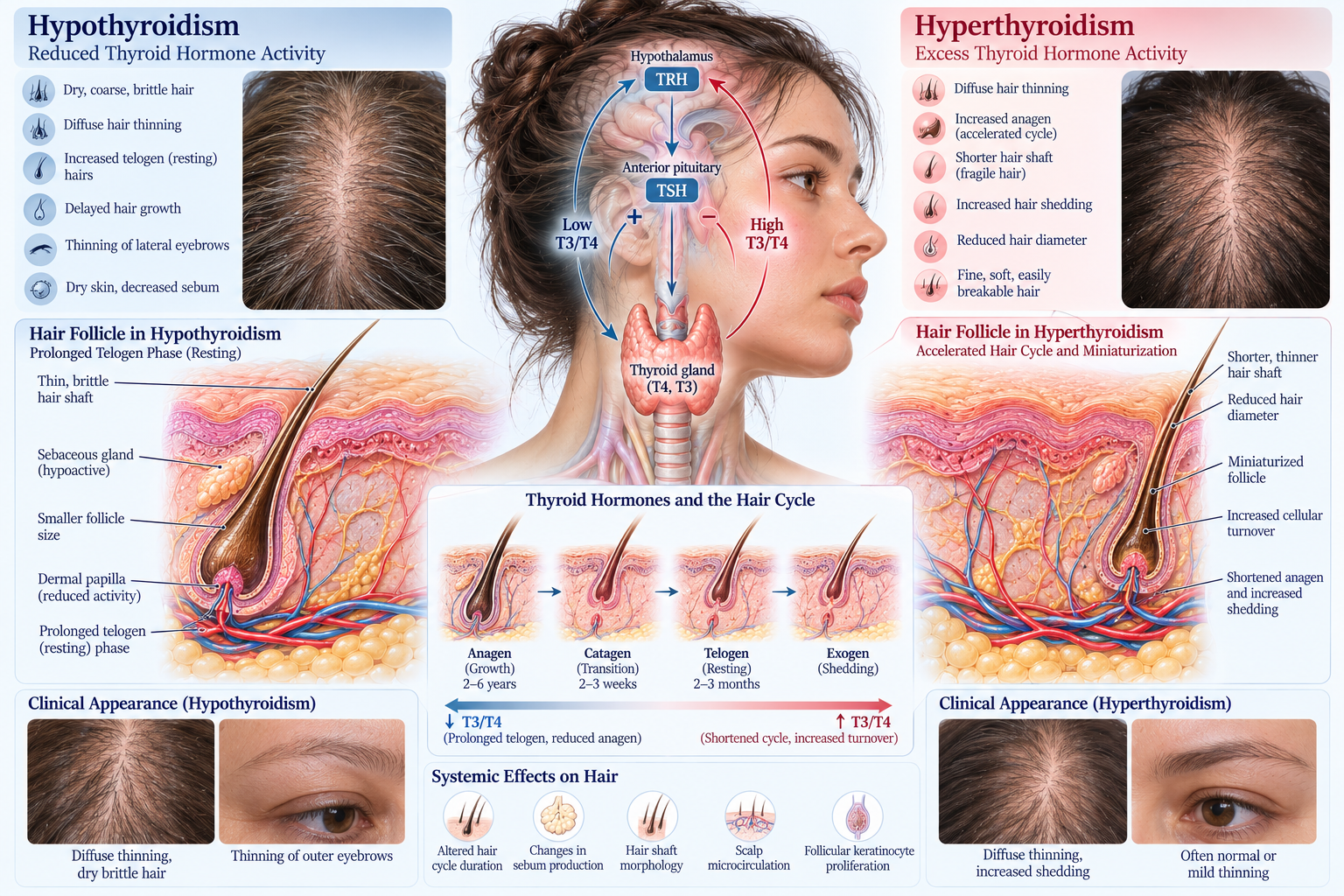
Clinical and Medical Illustration of Thyroid Disorders and Their Effects on Hair

Figure: The impact of hypothyroidism and hyperthyroidism on the hair follicle cycle and hair quality.

Metabolic Rate and Hair Follicle Dynamics

The thyroid gland, located in our neck, is one of the most critical endocrine centers governing the body's overall energy production and metabolic rate. As detailed in the image above, insufficient secretion of thyroid hormones (hypothyroidism) slows down the hair cycle, trapping it in the resting phase, while excessive secretion (hyperthyroidism) accelerates the cycle, leading to widespread hair thinning.

📌 Patient Information Section: What Does This Condition Mean?

What is the Connection Between Thyroid Hormones and Hair Health?

The butterfly-shaped thyroid gland in our neck controls our body's metabolic rate. The hormones it secretes directly affect the energy production, growth, and renewal cycle of hair follicles.

Hypothyroidism (Underactive Thyroid) and Hair Loss

When thyroid hormones are insufficient, metabolism slows down. Hair follicles enter the resting phase prematurely; hair becomes dull, dry, brittle, and widespread shedding begins. Thinning may sometimes also be observed in the outer parts of the eyebrows.

Hyperthyroidism (Overactive Thyroid) and Hair Loss

Excessive secretion of thyroid hormones, on the other hand, excessively speeds up metabolism. This disrupts the hair cycle, leading to thinning hair strands and diffuse hair loss.

What Should Be Done?

In cases of unexplained, widespread hair loss, thyroid functions must be examined through blood tests (TSH, free T3, free T4). When thyroid treatment is regulated, the hair cycle gradually returns to normal.

🩺 Clinical & Medical Guide for Physicians

Clinical Trichology Protocol: Hair Pathologies in Thyroid Disorders

  • Pathophysiology: Thyroid hormone receptors (TR-alpha and TR-beta) are highly expressed in hair follicle dermal papilla cells and outer root sheath keratinocytes. While hypothyroidism leads to prolonged telogen phase arrest and a decrease in matrix cell proliferation, hyperthyroidism accelerates the anagen-to-catagen transition, creating a picture of diffuse telogen effluvium.
  • Clinical Findings: In hypothyroidism, diffuse non-scarring alopecia, dry, coarse, and brittle hair strands are observed; in hyperthyroidism, fine, soft, and widespread thinning is noted. Thinning of the lateral one-third of the eyebrows (Hertoghe's sign) can be evaluated as a classic finding.
  • Diagnostic Approach: Serum TSH, Free T3, Free T4 levels, along with Thyroid Peroxidase Antibodies (Anti-TPO) and Thyroglobulin Antibodies (Anti-Tg), should be requested for screening for autoimmune thyroiditis (Hashimoto's or Graves' disease).
  • Evidence-Based Management: Achieving a euthyroid state with levothyroxine replacement or antithyroid medications is essential. Hair recovery after metabolic normalization typically occurs with a 3 to 6-month delay; supportive topical/systemic approaches may be necessary during this recovery period. Additionally, expertise and treatment approaches can be reviewed for clinical and surgical evaluations.

Scientific References and Bibliography

  • Bargujar P, Pahadiya HR. Hair loss in hypothyroidism. BMJ Case Rep. 2024 Jul 18;17(7):e260925. doi: 10.1136/bcr-2024-260925. PMID: 39025800. PubMed Link
  • Matsuura H, Suganami Y. Hypothyroidism, eyelash loss. Cleve Clin J Med. 2020 Nov 23;87(12):717. doi: 10.3949/ccjm.87a.20009. PMID: 33229385. PubMed Link
  • Messenger AG. Thyroid hormone and hair growth. Br J Dermatol. 2000 Apr;142(4):633-4. doi: 10.1046/j.1365-2133.2000.03521.x. PMID: 10792210. PubMed Link
  • Lause M, Kamboj A, Fernandez Faith E. Dermatologic manifestations of endocrine disorders. Transl Pediatr. 2017 Oct;6(4):300-312. doi: 10.21037/tp.2017.09.08. PMID: 29184811; PMCID: PMC5682371. PubMed Link

Thyroid Disorders (Hypothyroidism and Hyperthyroidism) and Hair Loss Frequently Asked Questions

Insights into the effect of thyroid hormone imbalances on the hair cycle, symptoms, and treatment approaches, with the expertise of Dr. Muhammet Özgehan Clinic.

The hormones secreted by the thyroid gland (T3 and T4) directly control the metabolism and growth cycle of hair follicles, just like almost every cell in the body. Dr. Muhammet Özgehan states that thyroid hormone imbalances slow down or disrupt the cellular activity of hair roots, causing hair to enter the resting phase (telogen phase) prematurely.

Both conditions affect hair structure in different ways: Hypothyroidism (underactive thyroid) slows down metabolism, leading to dry, dull, brittle hair and general diffuse shedding. Hyperthyroidism (overactive thyroid), on the other hand, accelerates metabolism, causing hair follicles to shed prematurely under stress and hair strands to thin. Dr. Muhammet Özgehan emphasizes that both these conditions are primary causes of hair loss due to telogen effluvium.

Successful hair treatment for thyroid disorders primarily depends on achieving hormonal balance. The current approaches followed at Dr. Muhammet Özgehan Clinic include:

  • Endocrinological and Dermatological Coordination: Comprehensive blood tests for thyroid hormone levels (TSH, free T3/T4, and antibodies) and collaboration with internal medicine/endocrinology.
  • Root Support After Hormonal Balancing: Mesotherapy and PRP protocols applied to rapidly improve hair quality after thyroid treatment has begun.
  • Metabolic and Vitamin Monitoring: Simultaneous replenishment of iron, ferritin, and B12 deficiencies that frequently accompany thyroid diseases.

Yes, hair loss due to thyroid disorders (when underlying hormone levels are brought to the ideal range and treatment is established) is largely not permanent; hair gradually begins to regrow over time. Dr. Muhammet Özgehan states that due to the slow working of the hair cycle, this recovery process can take several months, and patience is required during this period.

Thyroid patients should pay attention to the following points to protect their hair health and prevent sudden hair loss attacks:

  • Taking hormone medications (thyroid replacement therapies) regularly and at the time recommended by the physician.
  • Closely monitoring TSH levels with annual or semi-annual periodic blood tests.
  • Adopting nourishing and barrier-repairing medical care routines, avoiding aggressive chemicals that can dry out the scalp.

For Your Questions and Clinic Appointment

For any questions about thyroid disorders, hormonal hair loss, and treatment planning, or to schedule an examination appointment, you can contact Dr. Muhammet Özgehan Clinic immediately.