


Medical Hair Encyclopedia
Dermatological pathologies and evidence-based clinical guidelines at international standards.
CLINICAL GUIDELINE & PATHOLOGY
Lichen Simplex Chronicus (Chronic Itch-Scratch Cycle) – Diagnosis and Treatment Guide
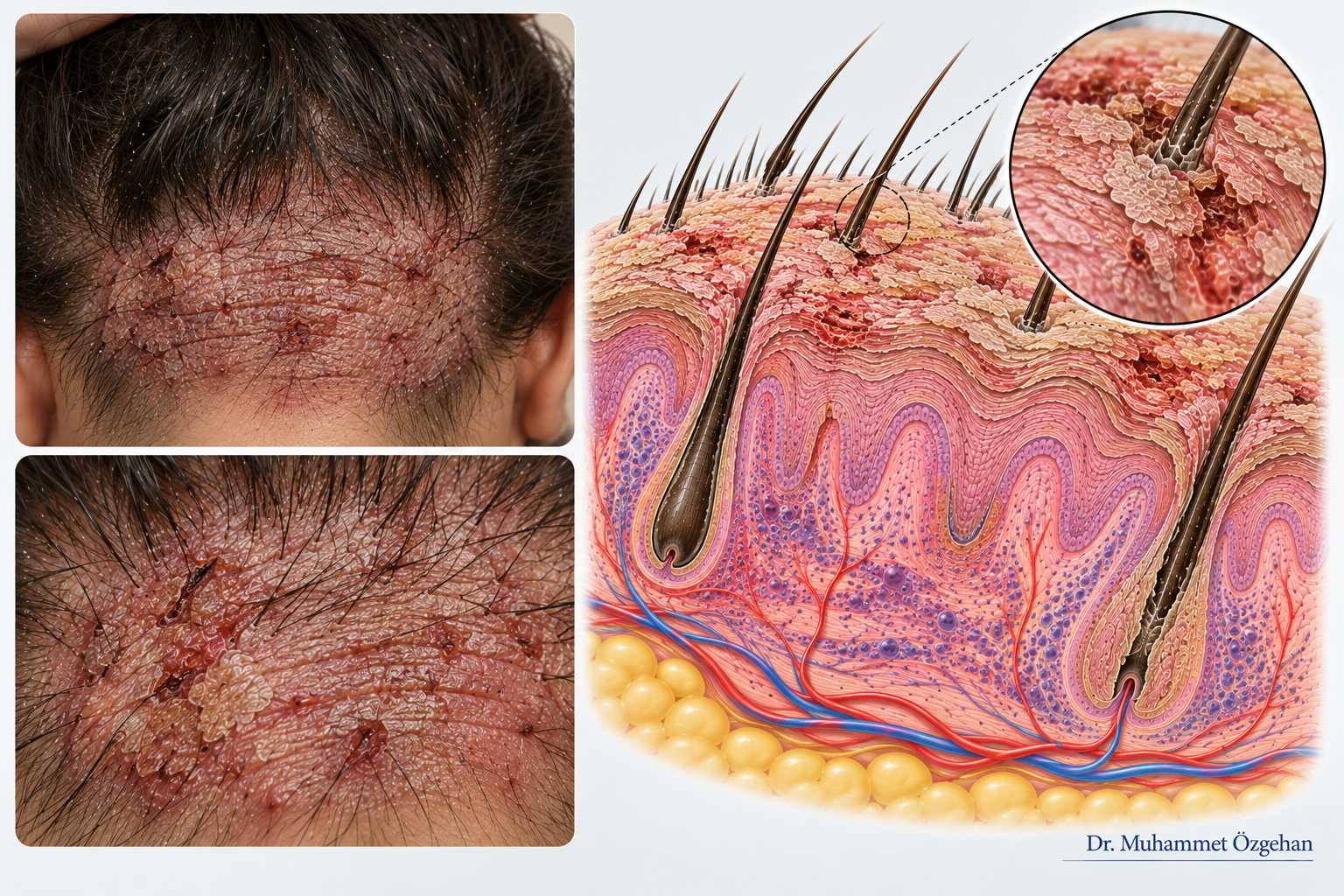
📌 Patient Information Section: What Does This Condition Mean?
Lichen simplex chronicus (neurodermatitis) arises from continuous scratching of a specific area of the scalp (typically the nape of the neck or the crown) due to stress, anxiety, or a mild itch trigger.
- What is the Itch-Scratch Cycle?: As the area is scratched, the individual feels relief; however, scratching further stimulates the skin nerves, intensifying the itch. This becomes a vicious cycle. Over time, the skin in that area becomes much thicker, harder, and leathery than normal.
- Does Hair Fall Out?: Due to continuous and severe trauma (scratching/nailing), hair strands in that area break or roots are damaged; this can lead to localized temporary hair thinning.
- What to Do?: This is not merely a physical skin problem but also related to hypersensitivity of nerve endings. Simply applying cream is insufficient; the scratching habit and stress factors must be broken.
🩺 Clinical & Medical Guide for Physicians
- Etiology and Pathophysiology: Development of epidermal hyperplasia due to chronic mechanical trauma (scratching, rubbing). Release of pruritogenic (itch-inducing) mediators and increased neuropathic sensitivity.
- Diagnostic Criteria and Clinical Findings: Single or multiple well-demarcated, thickened (lichenified), hyperkeratotic plaques with accentuated skin folds on the scalp, frequently in the occipital (nape) region. Excoriations and hyperpigmentation due to scratching.
- Dermoscopy (Trichoscopy) Findings: Whitish-gray thick hyperkeratotic areas, irregular brown/black pigment networks (melanophage accumulation) due to scratching trauma, broken hair shafts, and prominent vascular structures.
- Histopathological Diagnosis (Punch Biopsy):
- Biopsy Indication and Technique: A 4 mm punch biopsy is taken from thickened plaques where differentiation from other cicatricial or inflammatory alopecias (especially psoriasis or lichen planus) is difficult. Examination is performed with vertical sections.
- Pathological Findings: Striking epidermal acanthosis (thickening), hyperkeratosis, papillomatosis, irregular elongation of rete ridges ("saw-tooth" appearance), vertical thickening of collagen bundles in the dermis (fibrosis), and perivascular lymphocytic infiltrate.
- Current Treatment Protocols:
- Breaking the Cycle and Topical Treatments: Very potent topical corticosteroid ointments or occlusive dressings. Calcineurin inhibitors.
- Neuropathic Itch Relievers: Topical capsaicin, doxepin, or systemic neuromodulating agents (gabapentin, pregabalin) are planned under expert supervision to reduce hypersensitivity of nerve endings.
- Behavioral and Psychological Approach: Sedative antihistamines to prevent nighttime itching, and stress management/behavioral therapies. Additionally, expertise and treatment approaches can be reviewed for clinical and surgical evaluations.
Scientific References and Bibliography
- Moshkovich M, Andrade LF, Anderson M, Yosipovitch G. Lichen Simplex Chronicus: Clinical Perspectives and Emerging Therapeutic Strategies. Am J Clin Dermatol. 2025 Nov;26(6):895-903. doi: 10.1007/s40257-025-00979-z. Epub 2025 Aug 25. PMID: 40855389; PMCID: PMC12615567. PubMed Link
- Ju T, Vander Does A, Mohsin N, Yosipovitch G. Lichen Simplex Chronicus Itch: An Update. Acta Derm Venereol. 2022 Oct 19;102:adv00796. doi: 10.2340/actadv.v102.4367. PMID: 36250769; PMCID: PMC9677261. PubMed Link