


Medical Hair Encyclopedia
Dermatological pathologies and evidence-based clinical guidelines at international standards.
CLINICAL GUIDELINE & PATHOLOGY
Pediculosis Capitis (Head Lice and Parasitic Infestations) – Diagnosis and Treatment Guide
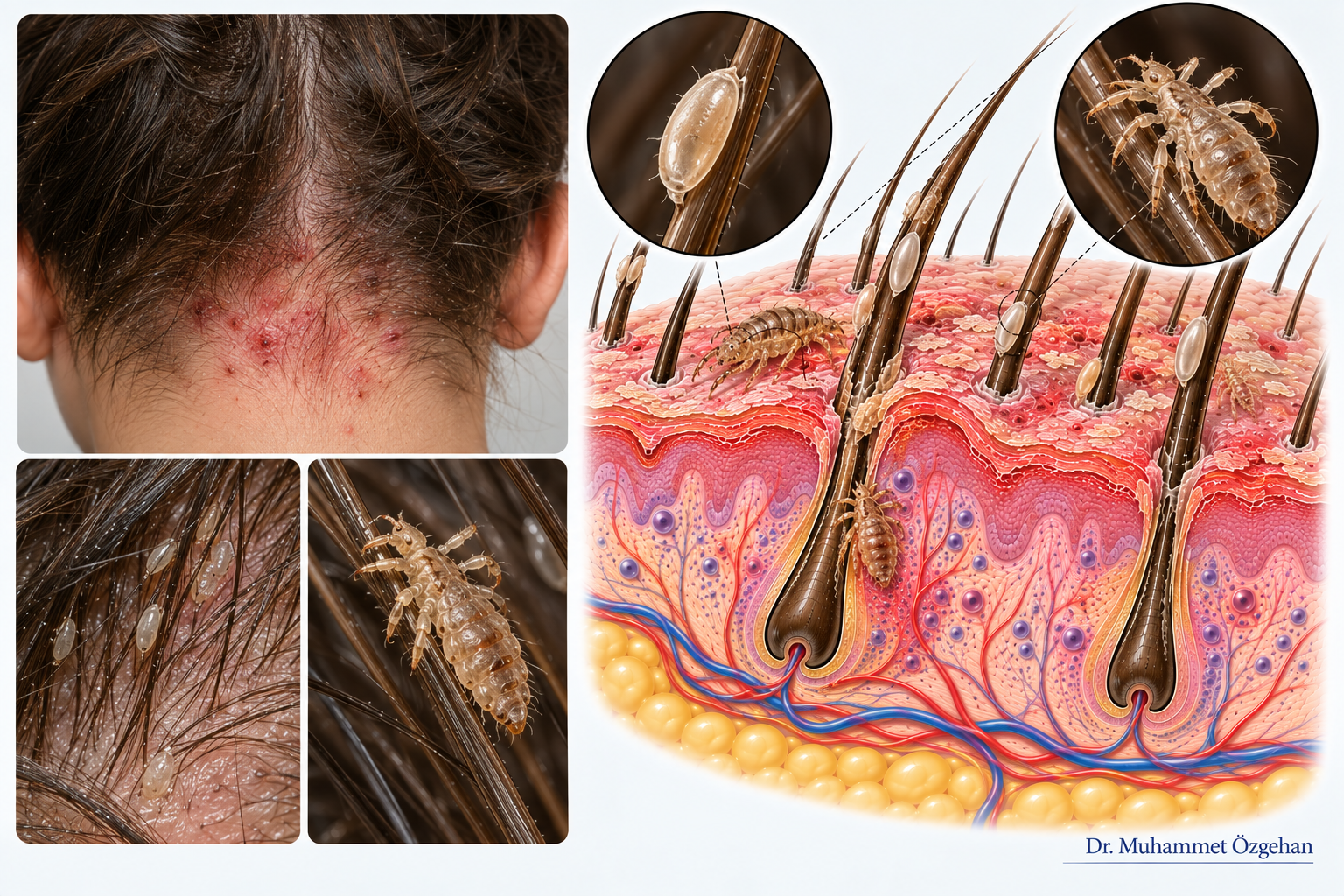
📌 Patient Information Section: What Does This Condition Mean?
Pediculosis capitis is a contagious infestation caused by the obligatory human parasite known as the head louse (Pediculus humanus capitis), which colonizes, feeds on, and reproduces in the scalp. It is absolutely not an indicator of poor personal hygiene; it can affect people from all social classes.
- How is it Transmitted?: It is transmitted through close head-to-head contact or by sharing items such as combs, brushes, hats, or pillows. Lice do not jump or fly; they only crawl.
- What are the Symptoms?: Severe itching behind the ears and at the nape of the neck (an allergic response to the parasite's secretions), skin irritation and crusting due to scratching, and increased restlessness at night. White/gray eggs (nits) are observed adhering to hair shafts, which, unlike dandruff, cannot be easily pulled off.
- What to Do?: Homemade herbal mixtures or ordinary shampoos do not provide a definitive solution. All family members should be screened, and treatment should be administered under expert supervision using medicated lice shampoos and special fine-toothed lice combs.
🩺 Clinical & Medical Guide for Physicians
- Etiology and Pathophysiology: Pediculus humanus capitis is an ectoparasite. It feeds several times a day by sucking blood from the scalp. The anticoagulant and vasodilatory proteins secreted in its saliva cause type I and type IV hypersensitivity reactions.
- Diagnostic Criteria and Clinical Findings: Intense itching in the occipital and retroauricular regions, excoriations, secondary impetiginization, and cervical lymphadenopathy. Detection of live lice or live nits located within 1 cm of the scalp.
- Dermoscopy (Trichoscopy) Findings: Oval, operculated nits firmly attached to the hair shaft, parasites moving at the hair roots, and traumatic vascular extravasation foci due to scratching.
- Histopathological Diagnosis (Indication and Findings):
- Biopsy Indication: Biopsy is not routinely required; however, a 4 mm punch biopsy may be taken in cases that are confused with atypical eczema.
- Pathology: Perivascular inflammation rich in eosinophils and mast cells may be observed around the infundibulum.
- Current Treatment Protocols:
- Topical Agents: Lotions and shampoos containing permethrin (1%) or dimethicone (suffocation by physical action). A second application after 7-10 days (for newly hatched eggs) is essential.
- Systemic Treatment: In resistant cases, oral Ivermectin (single dose or two doses 7 days apart, based on weight). If secondary bacterial infection is present, appropriate antibiotic therapy. Additionally, specialized and treatment approaches can be reviewed for clinical and surgical evaluations.
Scientific References and Bibliography
- Nutanson I, Steen CJ, Schwartz RA, Janniger CK. Pediculus humanus capitis: an update. Acta Dermatovenerol Alp Pannonica Adriat. 2008 Dec;17(4):147-54, 156-7, 159. PMID: 19104739. PubMed Link
- Khais Muri Laabusi A, Mohsan Rhadi M. Prevalence of Pediculus humunus capitis, Pediculus humanus corporis, and Pthirus pubis in Al-Kut, Iraq. Arch Razi Inst. 2022 Feb 28;77(1):497-501. doi: 10.22092/ARI.2022.357091.1969. PMID: 35891768; PMCID: PMC9288646. PubMed Link