


Medical Hair Encyclopedia
Dermatological pathologies and evidence-based clinical guidelines at international standards.
CLINICAL GUIDELINE & PATHOLOGY
Guide to Hair Shaft Disorders and Structural Anomalies
📌 Patient Information Section: What Does This Condition Mean?
Disorders in this group, rather than involving inflammation or shedding of hair follicles, are characterized by a genetically or structurally weak, fragile, or loosely attached hair fiber (shaft) to the root. It is non-scarring.
- Loose Anagen Syndrome (LAS): Typically observed in childhood. Hair does not firmly adhere to the scalp; it easily detaches painlessly from the root with very light combing or pulling.
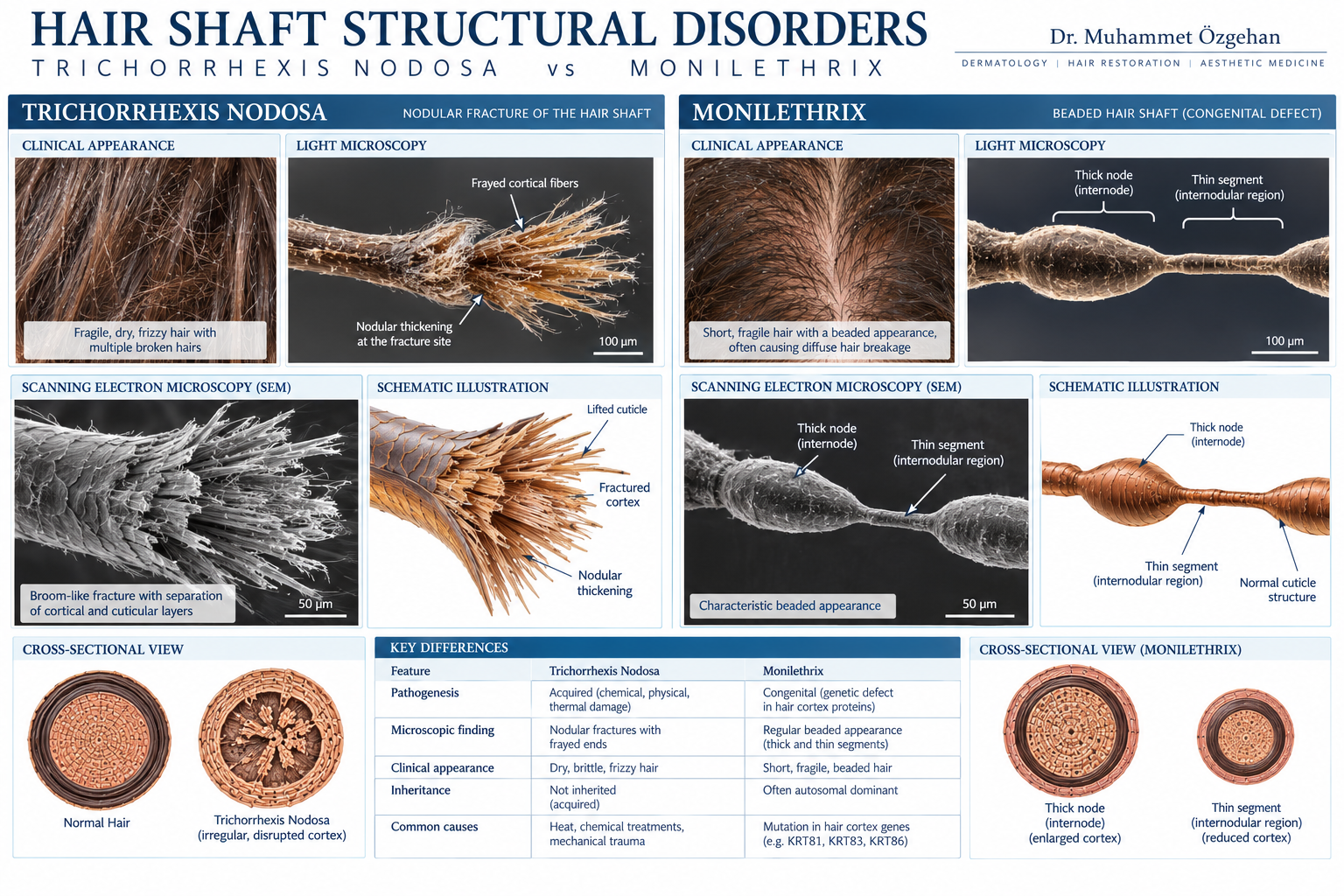
- Trichorrhexis Nodosa (Brittle Hair): This condition involves the formation of weak and fragile nodules along the hair shaft, causing the hair to easily break at these points.
- Monilethrix and Pili Torti: These are microscopic anomalies where hair strands appear beaded or twisted around their own axis.
🩺 Clinical & Medical Guide for Physicians
- Diagnostic Criteria and Findings:
- Loose Anagen Syndrome: In the pull test, numerous anagen hairs with their root sheaths detach painlessly with a single gentle pull. Additionally, specialized expertise and treatment approaches may be considered for clinical evaluations.
- Trichorrhexis Nodosa: Under microscopy, the fractured ends resemble two pressed-together brushes (brush-like appearance).
- Management and Treatment Protocols:
- Family Education: Information that conditions like Loose Anagen Syndrome are benign and tend to improve with age.
- Care Guide: Avoidance of harsh brushing, blow-dry heat, and chemical treatments; biotin and supportive supplements.
Scientific References and Bibliography
- Bhat YJ, Trumboo T, Krishan K. Hair Shaft Disorders in Children - An Update. Indian Dermatol Online J. 2023 Feb 23;14(2):163-171. doi: 10.4103/idoj.idoj_7_22. PMID: 37089857; PMCID: PMC10115339. PubMed Link
- Rudnicka L, Olszewska M, Waśkiel A, Rakowska A. Trichoscopy in Hair Shaft Disorders. Dermatol Clin. 2018 Oct;36(4):421-430. doi: 10.1016/j.det.2018.05.009. Epub 2018 Aug 16. PMID: 30201151. PubMed Link
- Drivenes JL, Bygum A, Hertz JM, Grimalt R, Puente-Pablo N. [Congenital hair shaft anomalies]. Ugeskr Laeger. 2021 May 31;183(22):V02210125. Danish. PMID: 34060455. PubMed Link
- Itin PH. Haarschaftanomalien [Hair shaft anomalies]. Praxis (Bern 1994). 1997 Jun 4;86(23):982-6. German. PMID: 9289799. PubMed Link