


Medical Hair Encyclopedia
Dermatological pathologies and evidence-based clinical guidelines at international standards.
NUTRITIONAL TRICHOLOGY & SUPPLEMENTS
Dietary Supplements, Vitamins, and Hair Loss Due to Nutritional Deficiency
📌 Patient Information Section: Which Essential Vitamins and Minerals Cause Hair Loss When Deficient?
Hair follicles are among the tissues with the highest rate of cell division in the body. Therefore, they are extremely sensitive to energy and nutrient deprivation. When nutrition is unbalanced or incorrect, or when certain vitamin-mineral stores are depleted, the body slows down hair production to protect vital organs and forces hair into the telogen (resting) phase, causing diffuse shedding.
- Iron and Ferritin Deficiency: Vital for the production of hemoglobin, which carries oxygen to hair follicles. When ferritin (stored iron) levels drop, telogen effluvium (diffuse hair loss) becomes inevitable.
- Zinc and Biotin: Involved in follicle DNA synthesis, tissue repair, and keratin production; deficiency leads to dullness and breakage in hair quality.
- Vitamin D and Vitamin B12: Play a key role in the stimulation of new hair follicles and the regulation of the cell cycle.
- Importance of Proper Nutrition: Instead of unconsciously used megadose vitamins, a balanced diet rich in protein, antioxidants, and healthy fatty acids (Mediterranean style) forms the foundation of hair health.
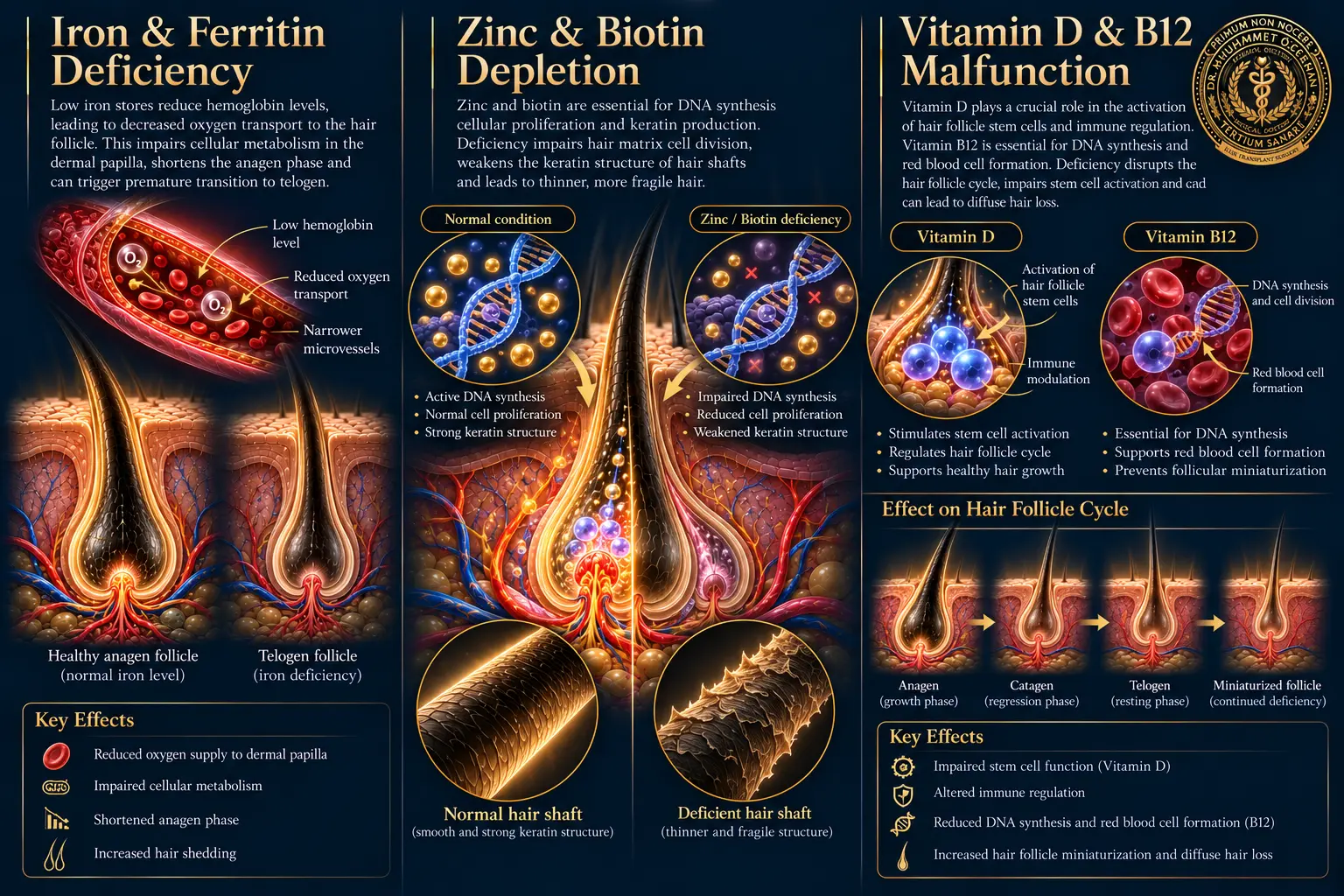
Figure: Mechanisms of microcirculation, cellular proliferation, and telogen phase transition in hair follicles due to iron, zinc, vitamin D, and B12 deficiencies.
🩺 Clinical & Medical Guide for Physicians
- Laboratory Screening Protocol: Quantitative evaluation of serum ferritin, iron-binding capacity, zinc, B12, folic acid, and 25-OH vitamin D levels in patients presenting with acute or chronic diffuse hair loss.
- Nutritional Correlation and Telogen Effluvium: Awareness that the risk of telogen hair loss increases exponentially when ferritin levels are below 40-50 ng/mL; planning of iron replacement therapy (IV/oral where necessary).
- Targeted Supplement Management: Creating rational supplement combinations, considering that high doses of elements without a detected deficiency can cause toxicity (e.g., excessive vitamin A or selenium causing paradoxical hair loss). Additionally, expertise and treatment approaches can be reviewed for clinical and surgical evaluations.
Scientific References and Bibliography
- Almohanna HM, Ahmed AA, Tsatalis JP, Tosti A. The Role of Vitamins and Minerals in Hair Loss: A Review. Dermatol Ther (Heidelb). 2019 Mar;9(1):51-70. doi: 10.1007/s13555-018-0278-6. Epub 2018 Dec 13. PMID: 30547302; PMCID: PMC6380979. PubMed Link
- Gokce N, Basgoz N, Kenanoglu S, et al. An overview of the genetic aspects of hair loss and its connection with nutrition. J Prev Med Hyg. 2022 Oct 17;63(2 Suppl 3):E228-E238. doi: 10.15167/2421-4248/jpmh2022.63.2S3.2765. PMID: 36479473; PMCID: PMC9710406. PubMed Link
- Pham CT, Romero K, Almohanna HM, et al. The Role of Diet as an Adjuvant Treatment in Scarring and Nonscarring Alopecia. Skin Appendage Disord. 2020 Mar;6(2):88-96. doi: 10.1159/000504786. Epub 2020 Jan 7. PMID: 32258051; PMCID: PMC7109385. PubMed Link
- Trost LB, Bergfeld WF, Calogeras E. The diagnosis and treatment of iron deficiency and its potential relationship to hair loss. J Am Acad Dermatol. 2006 May;54(5):824-44. doi: 10.1016/j.jaad.2005.11.110. PMID: 16632286. PubMed Link