


Medical Hair Encyclopedia
Dermatological pathologies and evidence-based clinical guidelines at international standards.
Myths, Misconceptions, and Scientific Facts in Hair Health: Why Are "Old Wives' Remedies" Dangerous?
📌 Patient Information Section: Hair Health from Historical Myths to Contemporary Misconceptions
Throughout history, hair loss has been one of humanity's greatest aesthetic concerns. It is even rumored that Roman Emperor Julius Caesar wore a laurel wreath to camouflage his baldness and resorted to numerous anecdotal methods, from snake oil to garlic cures (even though his baldness is iconically documented in his statues and busts!). Today, many misconceptions spread under the guise of barber advice, social media trends, and "old wives' remedies" not only fail to protect hair health but cause significant harm.
- Egg White and Bone Marrow Masks: Raw food masks applied to load protein onto hair cannot be absorbed into the hair shaft due to their molecular size; instead, they create a breeding ground for bacteria, foul odor, and infections on the scalp.
- Applying Garlic and Irritating Oils: Crushed garlic or heavy herbal oils applied directly to the scalp, mistakenly believed to promote hair growth, cause chemical burns, contact dermatitis, and permanent damage to hair follicles.
- Miracle-Promising Commercial Myths: These methods, lacking any dermatological or clinical evidence, cause patients with alopecia (hair loss) who require actual treatment to lose valuable time, leading to the progression of hair loss to an irreversible stage.
- The Golden Rule: No herbal or chemical product not recommended by a doctor or specialist dermatologist, and not clinically tested, should ever be applied to the scalp.
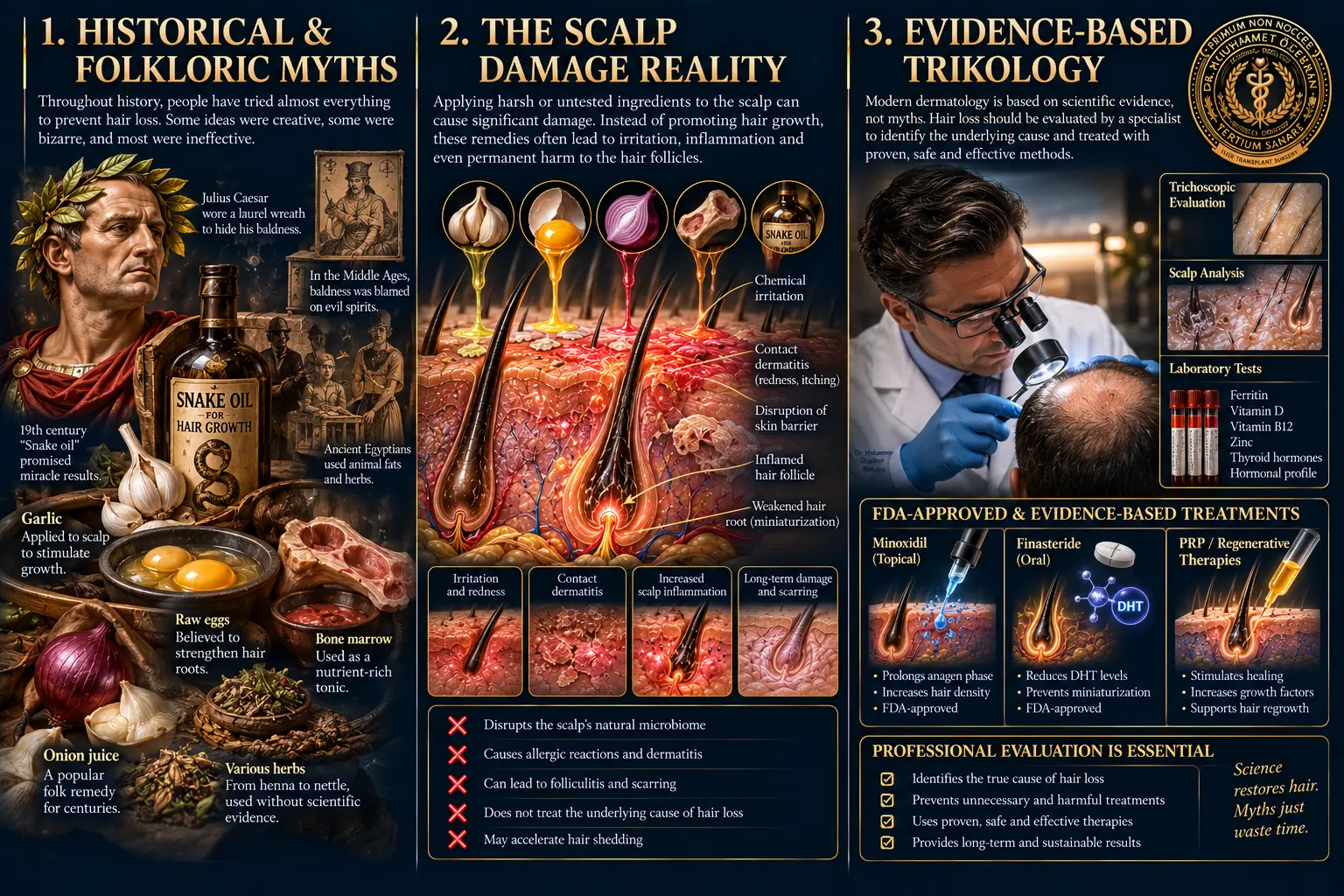
Figure: Historical and popular hair care myths (snake oil, garlic, egg masks) versus the risks of contact dermatitis these applications pose to the skin barrier, and evidence-based trichology approaches.
🩺 Clinical & Medical Guide for Physicians
- Irritant Contact Dermatitis and Folliculitis Etiology: Mechanisms by which homemade remedies (e.g., pure garlic, chili pepper extracts, acidic plant juices) unconsciously applied by patients disrupt the stratum corneum barrier, leading to acute irritant contact dermatitis, erythema, edema, and secondary bacterial folliculitis.
- Risk of Cicatricial Alopecia: Clinical presentations where deep inflammation caused by aggressive chemical or herbal agents on the scalp destroys hair follicles, leading to permanent (scarring) alopecias.
- Evidence-Based Trichological Approach: Guiding patients away from popular culture myths towards a rational treatment plan with FDA-approved pharmacological agents (Minoxidil, Finasteride, etc.) and evidence-based regenerative therapies (PRP, Mesotherapy). Additionally, expertise and treatment approaches for clinical and surgical evaluations can be reviewed.
Scientific References and Bibliography
- Lim HW, Zhang C, Taylor M, et al. International Expert Consensus on Knowledge Gaps in Care for Dermatologic Disorders in Skin of Color. Int J Dermatol. 2026 Jan;65(1):41-56. doi: 10.1111/ijd.70101. Epub 2025 Nov 6. PMID: 41195756; PMCID: PMC12712774. PubMed Link
- Douglas A, Onalaja AA, Taylor SC. Hair care products used by women of African descent: review of ingredients. Cutis. 2020 Apr;105(4):183-188. PMID: 32463850. PubMed Link
- Trueb RM. Causes and management of hair loss. G Ital Dermatol Venereol. 2018;153(4):541-556.
- Miteva M, Tosti A. Adverse effects of "natural" and folk remedies on the scalp and hair. Dermatol Clin. 2014;32(2):189-205.