


Medical Hair Encyclopedia
Dermatological pathologies and evidence-based clinical guidelines at international standards.
TOPICAL PRODUCTS & DERMATOLOGICAL CARE
Shampoos, Hair Care Products, and Medical Trichology Treatments
📌 Patient Information Section: What Are the Actual Limits of Cosmetic Shampoos' Efficacy?
Many cosmetic shampoos and hair care products sold on the market promise to "miraculously strengthen hair against shedding." However, dermatological realities and skin physiology indicate that their effect is quite limited:
- Skin Barrier and Follicle Access: The stratum corneum layer of the scalp (skin barrier) largely prevents large molecules in cosmetic products from reaching the hair follicles (dermal papilla). Therefore, the effect of shampoos in stopping hair loss from the root is almost negligible.
- Temporary Effect on Hair Shaft: The hair shaft, in its part remaining above the skin, consists of dead cells (keratin). Cosmetic care products (silicones, proteins, oils) coat this dead structure, providing temporary shine, softness, and volume (sensation of thickness); however, this effect is not permanent and disappears with the first wash.
- Role of Medical Shampoos: When pathological conditions such as dandruff, redness, itching, and scaling (seborrheic dermatitis) are present on the scalp, medical shampoos containing special active ingredients come into play.
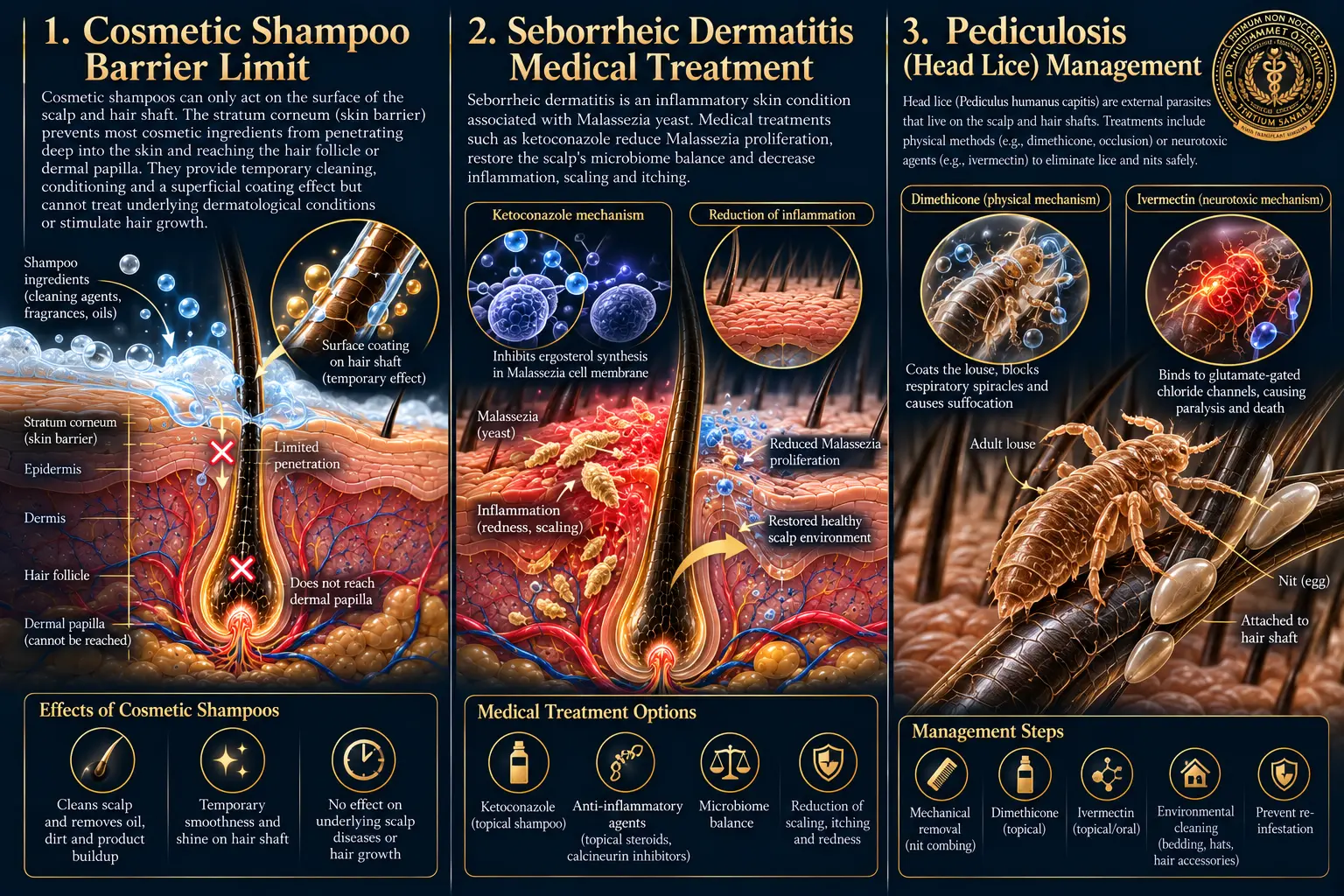
Figure: Skin barrier limitations of cosmetic products, temporary keratin coating effects on the hair shaft, and medical mechanisms of action for seborrheic dermatitis and head lice (pediculosis).
🩺 Clinical & Medical Guide for Physicians
- Medical Molecules in Seborrheic Dermatitis and Scalp Pathologies:
- Ketoconazole (2%): Antifungal effect suppressing Malassezia furfur (pityrosporum ovale) proliferation, and weak anti-androgenic/anti-inflammatory properties.
- Zinc Pyrithione / Selenium Sulfide: Antimicrobial effect and regulation of stratum corneum turnover (cell renewal rate).
- Coal Tar and Salicylic Acid: Antiproliferative and keratolytic effects, removing thickened scales.
- Active Ingredient Recommendations for Clinicians in the Management of Pediculosis Capitis (Head Lice):
- Dimethicone (4%): Silicone-based lotions acting via a physical mechanism; they physically block the respiratory spiracles of lice and nits, suffocating them without developing resistance (first-line safe approach).
- Ivermectin (0.5% Topical): A modern antiparasitic agent targeting GABA receptors in the nervous system of lice, causing hyperpolarization, paralysis, and death.
- Permethrin (1%): A classic pyrethroid derivative with neurotoxic effects; however, considering resistance rates in some regions, a second application (repeat) protocol should be planned after 7-10 days.
Scientific References and Bibliography
- Chen D, Yu F, Wang C, et al. Anti-hair loss effect of a shampoo containing caffeine and adenosine. J Cosmet Dermatol. 2024 Sep;23(9):2927-2933. doi: 10.1111/jocd.16347. PMID: 38764299. PubMed Link
- Gavazzoni Dias MF. Hair cosmetics: an overview. Int J Trichology. 2015 Jan-Mar;7(1):2-15. doi: 10.4103/0974-7753.153450. PMID: 25878443; PMCID: PMC4387693. PubMed Link
- Dall'Oglio F, Nasca MR, Gerbino C, Micali G. An Overview of the Diagnosis and Management of Seborrheic Dermatitis. Clin Cosmet Investig Dermatol. 2022 Aug 6;15:1537-1548. doi: 10.2147/CCID.S284671. PMID: 35967915; PMCID: PMC9365318. PubMed Link
- Karthikeyan K, Aishwarya M, Elayaperumal S. Effectiveness of Topical 0.5% Ivermectin Shampoo in the Treatment of Pediculosis Capitis among School-going Female Children. Int J Trichology. 2022 Mar-Apr;14(2):55-59. doi: 10.4103/ijt.ijt_157_20. PMID: 35531485; PMCID: PMC9069911. PubMed Link