Medical Hair Encyclopedia
Dermatological pathologies and evidence-based clinical guidelines at international standards.
Medication Use and Drug-Induced Hair Loss
Prepared by: Dr. Muhammet Özgehan | Turkish Hair and Scalp Diseases Association
This guide has been compiled by Dr. Muhammet Özgehan in light of current literature.

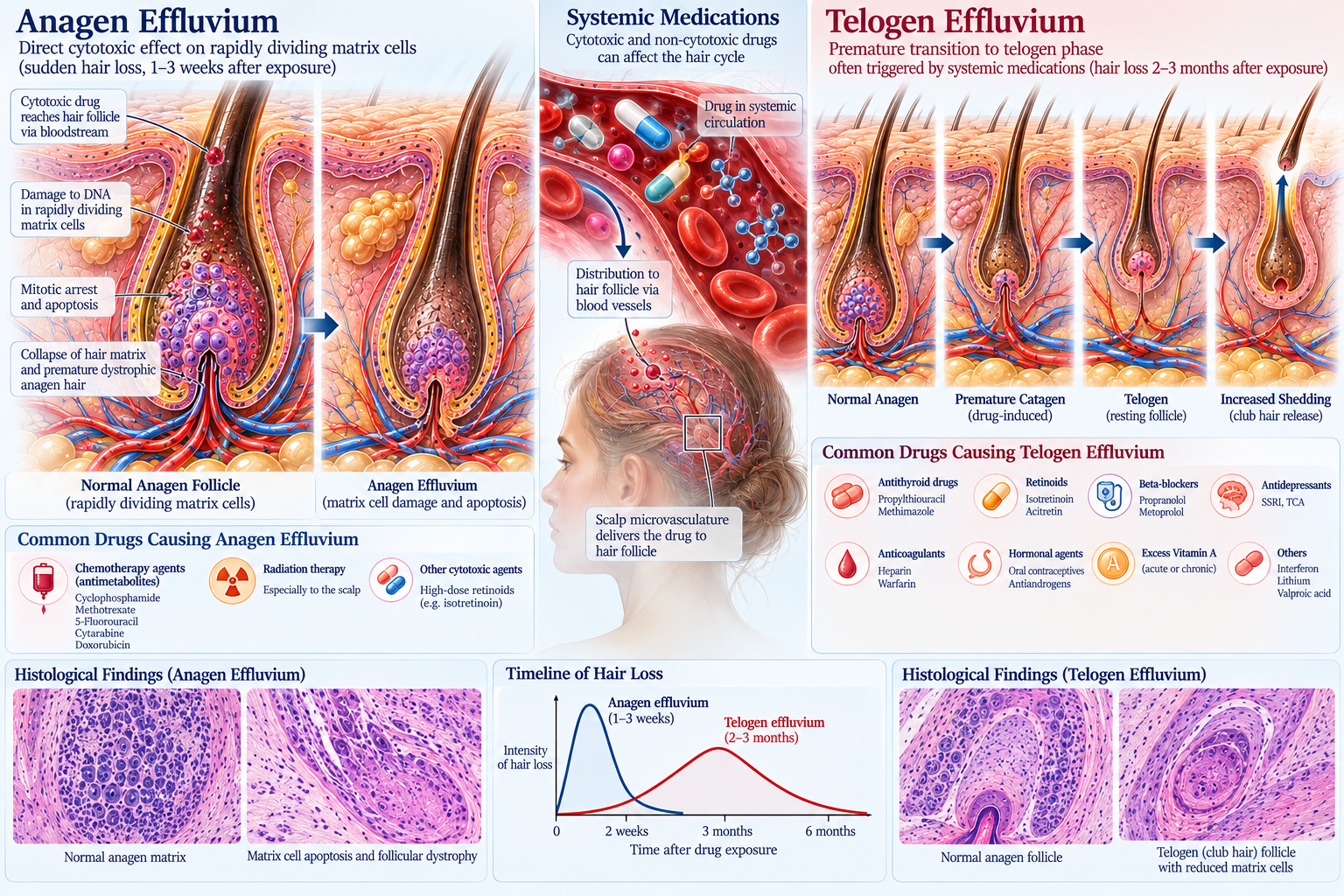
Figure: Mechanisms of action of systemic pharmacological agents on the hair follicle cycle (Anagen and Telogen phases).
Pharmacological Agents and Hair Follicle Interaction
Many systemic medications can lead to hair loss by targeting the high metabolic activity or cell division cycle of hair follicles. As summarized in the visual above, this typically occurs through two main mechanisms: Anagen Effluvium, which directly halts cell division, or Telogen Effluvium, which forces hairs into an early resting phase.
Common Drug Groups and Types of Hair Loss
| Drug Class / Active Ingredient Group | Type of Loss | Clinical Feature and Onset Time |
|---|---|---|
| Chemotherapeutics (Cytotoxic Agents) | Anagen Effluvium | Halts rapid cell division; sudden and severe shedding occurs days/weeks after treatment. |
| Anticoagulants (Blood Thinners: Heparin, Warfarin, etc.) | Telogen Effluvium | Forces hair into an early resting phase; typically begins with diffuse shedding 2-4 months after starting the medication. |
| Retinoids (Vitamin A Derivatives: Isotretinoin, etc.) | Telogen Effluvium | Accelerates the hair cycle in a dose-dependent manner; can cause diffuse thinning during treatment. |
| Anticonvulsants and Mood Stabilizers | Telogen Effluvium | Valproic acid and similar agents can lead to chronic hair thinning with long-term use. |
| Thyroid Medications / Hormonal Agents | Telogen Effluvium | Temporary hair loss can be triggered during dose adjustment periods or sudden hormonal changes. |
| Beta Blockers and Blood Pressure Medications | Telogen Effluvium | Although rare, some cardiovascular agents can prematurely shorten the hair follicle cycle. |
📌 Patient Information Section: What Does This Condition Mean?
Will My Medication Cause Hair Loss?
Many prescription and over-the-counter medications can cause hair loss. This typically manifests in two ways: sudden, inhibitory shedding caused by drugs like chemotherapy (Anagen Effluvium), or diffuse shedding triggered several months later by blood pressure medications, blood thinners, or acne medications (Telogen Effluvium).
Is Drug-Induced Hair Loss Permanent?
Contrary to popular belief, the vast majority of medication-related hair loss is temporary. After the medication is discontinued or completely eliminated from the body, the hair cycle spontaneously returns to normal, and hair begins to regrow.
Critical Warning: Never Stop Your Medication Yourself!
If you suspect your hair loss is caused by a medication you are using, never discontinue or change your medication without consulting your specialist physician. You can discuss alternative safe options with the doctor managing your treatment.
🩺 Clinical & Medical Guide for Physicians
Clinical Trichology Protocol: Management of Drug-Induced Alopecia
- Pathophysiology: Drug-induced alopecia manifests in two primary forms. Anagen Effluvium: Direct cytotoxic/mitotic arrest on rapidly proliferating matrix keratinocytes (most commonly seen with chemotherapeutics). Telogen Effluvium: Premature forcing of anagen-phase follicles into catagen/telogen phase (retinoids, anticoagulants, anticonvulsants, and beta-blockers).
- Clinical Assessment and History: A detailed pharmacological anamnesis should be taken. For telogen effluvium, a medication history from 2 to 4 months prior to shedding should be obtained; for anagen effluvium, cytotoxic exposure days to weeks prior should be investigated.
- Management and Approach: The patient should be reassured that the condition is temporary. If clinically feasible, a switch to alternative pharmacological agents should be made, and supportive trichological care protocols should be applied when necessary. Additionally, expertise and treatment approaches for clinical and surgical evaluations can be reviewed.
Scientific References and Bibliography
- Alhanshali L, Buontempo M, Shapiro J, Lo Sicco K. Medication-induced hair loss: An update. J Am Acad Dermatol. 2023 Aug;89(2S):S20-S28. doi: 10.1016/j.jaad.2023.04.022. PMID: 37591561. PubMed Link
- Ben Salem C, Ben Abdelkrim A. Medication-induced hair loss: An update. J Am Acad Dermatol. 2024 Jan;90(1):e43. doi: 10.1016/j.jaad.2023.09.056. Epub 2023 Sep 28. PMID: 37776901. PubMed Link
- Patel M, Harrison S, Sinclair R. Drugs and hair loss. 2013 Jan;31(1):67-73. doi: 10.1016/j.det.2012.08.002. Epub 2012 Sep 18. PMID: 23159177. PubMed Link
Medication Use and Drug-Induced Hair Loss Frequently Asked Questions
Questions about the effect of medications on hair loss, telogen effluvium, anagen effluvium, and treatment approaches, with the expertise of Dr. Muhammet Özgehan Clinic.
Many different categories of systemic medications can affect the hair cycle and lead to hair loss. Dr. Muhammet Özgehan lists the most common drug groups causing hair loss in clinical practice as follows:
- Chemotherapy Drugs (Cancer Treatments): By targeting rapidly dividing cells, they cause sudden and widespread hair loss known as anagen effluvium.
- Blood Thinners (Anticoagulants): Medications like heparin or warfarin can trigger hair to enter an early resting phase.
- Thyroid Medications and Hormones: Dosage imbalances or birth control pills can create hormonal fluctuations leading to shedding.
- Antihypertensives and Heart Medications: Beta-blockers and some cholesterol-lowering agents can negatively affect the hair cycle.
- Antidepressants and Mood Stabilizers: Some psychiatric medications can trigger telogen effluvium.
The effect of medications on hair primarily occurs through two different pathways: Telogen Effluvium (mass shedding of hair after a few months of medication use as it enters the resting phase, as seen with blood pressure or antidepressant medications) and Anagen Effluvium (sudden and intense hair loss due to direct poisoning of actively growing hair follicles or cessation of cell division, typically seen in chemotherapy). Dr. Muhammet Özgehan states that the type of shedding varies depending on the active ingredient of the medication and the duration of use.
In most cases of drug-induced hair loss (especially telogen effluvium or anagen effluvium after chemotherapy), the hair cycle spontaneously returns to normal, and hair begins to regrow after the responsible medication is discontinued or treatment is completed. Dr. Muhammet Özgehan emphasizes that this recovery process can take several months, but in some special circumstances or with chronic medication use, dermatological supplements and treatments may be needed to support hair quality.
For drug-induced hair loss, the primary rule is to plan alternative medications in coordination with the relevant physician, without disrupting the patient's vital treatments. The supportive approaches applied at Dr. Muhammet Özgehan Clinic include:
- Detailed Medication and History Analysis: Identification of all prescription/over-the-counter medications and supplements recently used by the patient.
- Hair Follicle Revitalization Protocols: PRP, mesotherapy, or medical vitamin treatments applied to accelerate the hair cycle's return to normal.
- Multidisciplinary Follow-up: Monitoring the patient's metabolic and hormonal balance in collaboration with internal medicine or relevant specialty departments.
Maintaining hair health in individuals who must use medication continuously due to chronic illnesses requires special attention. Dr. Muhammet Özgehan offers the following recommendations to these patients:
- Never discontinue medications without physician approval; instead, share hair loss concerns with the relevant specialist to evaluate alternative molecular options.
- Regularly check vitamin, mineral, and ferritin levels and address potential deficiencies early.
- Seek dermatological support for clinical care treatments that support scalp microcirculation and for a proper hair care routine.
For Your Questions and Clinic Appointment
For questions about hair loss related to your medications, telogen effluvium, and personalized hair treatment planning, or to schedule an examination appointment, you can contact Dr. Muhammet Özgehan Clinic immediately.