


Medical Hair Encyclopedia
Dermatological pathologies and evidence-based clinical guidelines at international standards.
CLINICAL GUIDELINE & PATHOLOGY
Keratosis Pilaris Atrophicans Faciei (KPAF) – Diagnosis and Treatment Guide
📌 Patient Information Section: What Does This Condition Mean?
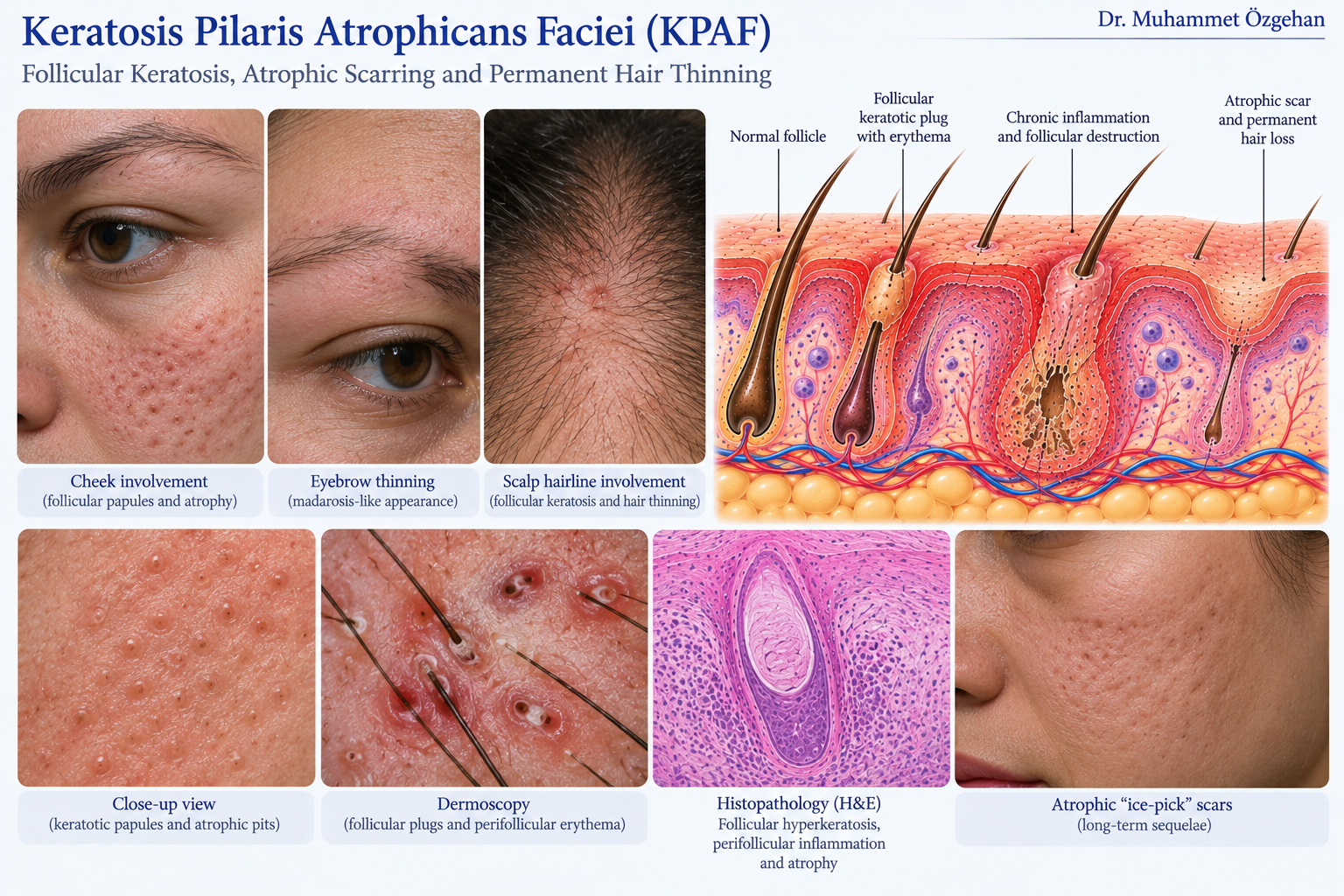
Keratosis Pilaris Atrophicans Faciei (KPAF) is a rare hereditary skin and hair/eyebrow condition, typically beginning in childhood or adolescence, characterized by the obstruction of hair follicles with a hard substance called keratin, and over time leading to permanent atrophy (thinning/depression) and hair loss around the follicles.
- Affected Areas: Most commonly observed on the cheeks, in front of the ears, and on the outer parts of the eyebrows, presenting as redness, bumpiness, and subsequent permanent hair loss (thinning of eyebrows). It can also extend to the scalp borders.
- Symptoms: Small, punch-out-like depressions (atrophy) in the skin, follicular papules, and permanent hair loss.
- What to Do: Standard moisturizers do not reverse this condition. Early dermatological follow-up and keratoregulatory treatments are essential to prevent permanent scarring and tissue loss.
🩺 Clinical & Medical Guide for Physicians
- Etiology and Pathophysiology: Abnormal keratinization of the follicular epithelium, obstruction of the follicular ostium, formation of a keratin plug within the follicle, and accompanying mild inflammation that destroys the follicular structure, leading to cicatricial (atrophic) loss (autosomal dominant forms have been reported).
- Diagnostic Criteria and Clinical Findings: Symmetrical erythematous follicular papules on the cheeks and eyebrow area, follicular keratotic plugs, permanent cicatricial alopecia on the lateral eyebrows, and "atrophic depressions" (vergetures / ice-pick-like scars) on the face. Differential diagnosis with frontal fibrosing alopecia may be necessary.
- Dermoscopy (Trichoscopy) Findings: Yellowish-white keratin plug rings obstructing hair ostia, peri-follicular erythema around them, and fibrotic/atrophic white areas (areas where hair follicles are absent).
- Histopathological Diagnosis (Punch Biopsy):
- Biopsy Indication: A 4 mm punch biopsy is taken in cases of atypical cicatricial alopecias and those confused with follicular keratoses.
- Pathology: Obstructed keratin plug in the infundibulum, atrophy of the follicular wall, loss of elastic fibers in the dermis, and mild perivascular/perifollicular lymphocytic infiltrate.
- Current Treatment Protocols:
- Keratolytic and Retinoid Treatments: Removal of keratin plugs with topical retinoic acid, salicylic acid, or urea-containing creams. Systemic isotretinoin (low dose) may be used in selected resistant cases to suppress fibrosis.
- Laser and Cosmetic Approaches: Vascular lasers for erythema, fractional laser (e.g., 585 nm diode or fractional solid-state lasers) applications for atrophic scars. Additionally, expert and treatment approaches can be reviewed for clinical and surgical evaluations.
Scientific References and Bibliography
- Fekete GL, Fekete L, Neagu N, Bacârea V, Drăgănescu M, Brihan I. Keratosis pilaris atrophicans faciei: An observational, descriptive, retrospective clinical study. Exp Ther Med. 2021 Nov;22(5):1331. doi: 10.3892/etm.2021.10766. Epub 2021 Sep 20. PMID: 34630685; PMCID: PMC8495552. PubMed Link
- Gönülal M, Karaca S, Balcı DD. Keratosis Pilaris Atrophicans Faciei: A Case Treated with 585 nm Diode Laser, a Novel Fractional Solid-State. Clin Cosmet Investig Dermatol. 2023 Dec 4;16:3497-3501. doi: 10.2147/CCID.S441779. PMID: 38077919; PMCID: PMC10706048. PubMed Link
- Desai DD, Nohria A, Shapiro J, Lo Sicco KI. Navigating Diagnostic Uncertainty: Frontal Fibrosing Alopecia Versus Keratosis Pilaris Atrophicans Faciei With Genetic Testing Insights. Cureus. 2024 Apr 23;16(4):e58830. doi: 10.7759/cureus.58830. PMID: 38784309; PMCID: PMC11114203. PubMed Link