Medical Hair Encyclopedia
Dermatological pathologies and evidence-based clinical guidelines at international standards.
Tractional and Traumatic Alopecias Diagnosis and Treatment Guide
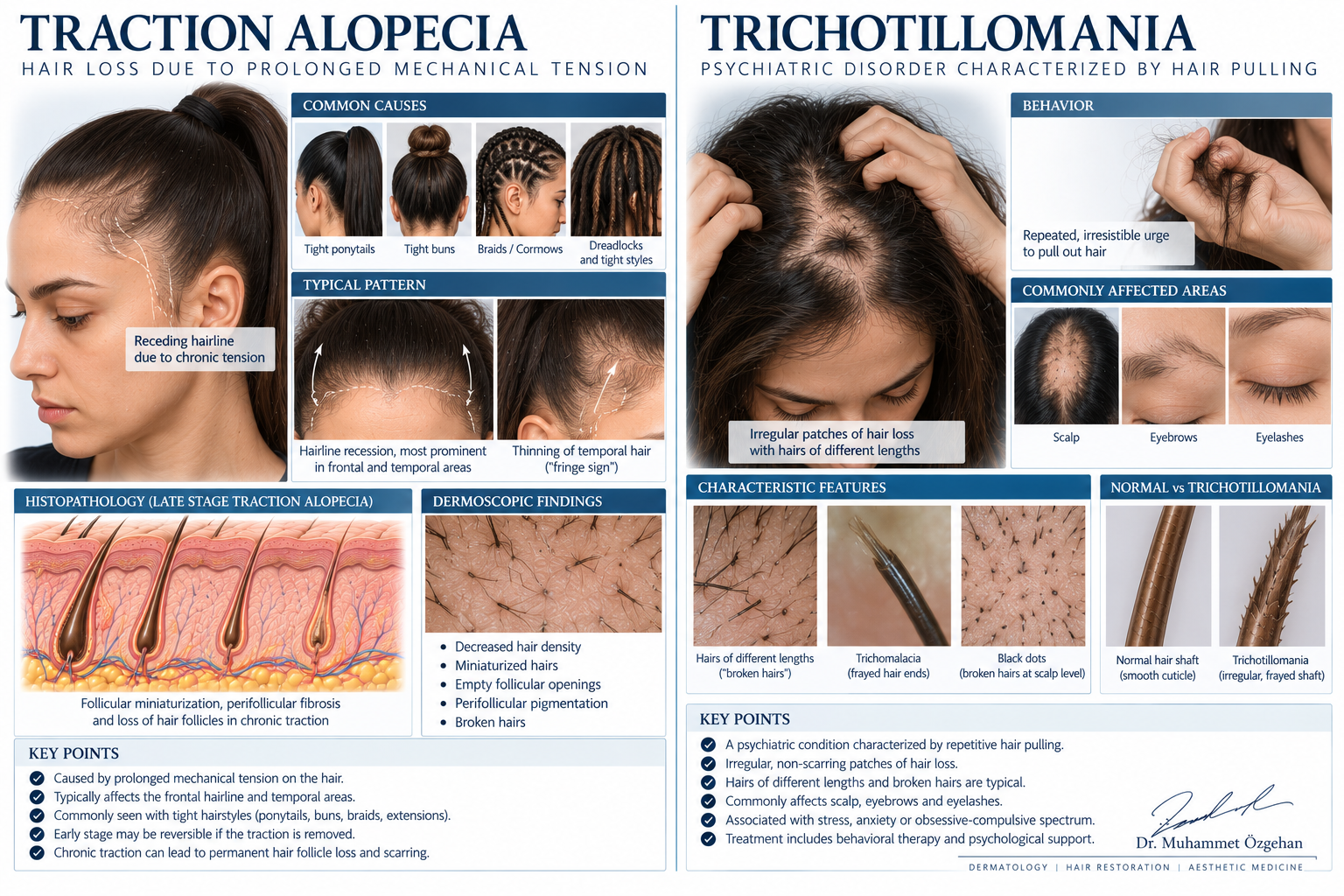
Prepared by: Dr. Muhammet Özgehan | Turkish Hair and Scalp Diseases Association
This guide has been compiled by Dr. Muhammet Özgehan in light of current literature.

📌 Patient Information Section: What Does This Condition Mean?
These types of hair loss occur not due to an internal bodily disease, but as a result of physical pulling, stretching, or tearing (mechanical trauma) forces applied externally to the hair follicles. They are examined in two main groups:
- Traction Alopecia (Physical Pulling): This is damage to the roots caused by constantly wearing very tight ponytails, braids, using heavy hair extensions, or tying headscarves too tightly at the same point. If hair styles are loosened in the early stages, hair can fully recover.
- Trichotillomania (Hair Pulling Disorder): This is a psychodermatological condition where an individual, due to intense stress, anxiety, or unconsciously, acts on an urge to constantly pull and tear out their own hair, eyebrows, or eyelashes. It is not a shameful condition; it is a treatable impulse control disorder.
🩺 Clinical & Medical Guide for Physicians
- Diagnostic Criteria and Clinical Findings:
- Traction Alopecia: History of recession in the frontal hairline or temples. Small, fine "fringe hairs" immediately anterior to the traction line and perifollicular erythema are typical.
- Trichotillomania: Irregular and oddly geometric areas of thinning on the scalp, rather than completely bald patches. Dermoscopy reveals broken hairs of varying lengths, with irregular, coiled, or spiral tips ("bizarre" fractures).
- Current Management and Treatment Protocols:
- Mechanical and Behavioral Regulation: Immediate cessation of physical tension on the hair. In cases of trichotillomania, psychiatry/psychology consultation (Cognitive Behavioral Therapy - CBT) must be planned in addition to dermatological support.
- Follicular Supports: Topical minoxidil or mesotherapy support in early-stage cases. In advanced and scarred cases, hair transplant surgery as a surgical option.
Scientific References and Bibliography
- Bohn M, Thomsen PH, Nissen JB. [Trichotillomani]. Ugeskr Laeger. 2022 May 9;184(19):V11210829. Danish. PMID: 35593367. PubMed Link
- Grant JE, Chamberlain SR. Trichotillomania. Am J Psychiatry. 2016 Sep 1;173(9):868-74. doi: 10.1176/appi.ajp.2016.15111432. PMID: 27581696; PMCID: PMC5328413. PubMed Link
- Christensen RE, Tan I, Jafferany M. Recent advances in trichotillomania: a narrative review. Acta Dermatovenerol Alp Pannonica Adriat. 2023 Dec;32(4):151-157. PMID: 38126097. PubMed Link
- Larrondo J, McMichael AJ. Traction Alopecia. JAMA Dermatol. 2023 Jun 1;159(6):676. doi: 10.1001/jamadermatol.2022.6298. PMID: 37133879. PubMed Link
- Syed HA, Kaliyadan F. Traction Alopecia. 2025 May 4. In: StatPearls [Internet]. Treasure Island (FL): StatPearls Publishing; 2026 Jan–. PMID: 29262008. PubMed Link
Frequently Asked Questions About Tractional, Traumatic, and Trichotillomania Hair Loss
Frequently asked questions about traction-related hair loss, trichotillomania (hair-pulling disorder), and treatment approaches with the expertise of Dr. Muhammet Özgehan Clinic.
Traction alopecia is a type of hair loss that occurs as a result of long-term and repetitive mechanical pulling (tension) forces applied to the hair follicles. Dr. Muhammet Özgehan states that tight ponytails, braids (Afro-braids), pompadour styles, excessively tight buns, hair extensions, and constant harsh brushing in the same direction pave the way for this condition.
Trichotillomania is a psychodermatological impulse control disorder where an individual feels an irresistible urge to pull out their own hair, eyebrows, or eyelashes. It causes irregular, patchy areas of hair loss with broken hair shafts of varying lengths on the scalp. Dr. Muhammet Özgehan emphasizes that this condition can lead to both mechanical trauma and follicular damage, potentially causing permanent thinning of the scalp over time.
Hair regrowth depends on how long the follicles have been subjected to trauma or the pulling action. If the roots are not yet permanently damaged, hair may regrow spontaneously over time once the pulling behavior stops. However, Dr. Muhammet Özgehan emphasizes that in chronic trichotillomania cases lasting many years, fibrosis (scar tissue) may develop in the hair follicles, increasing the risk of permanent alopecia in these areas.
The most important step in treatment is stopping the mechanical destruction and the behavioral cycle. Current approaches implemented at Dr. Muhammet Özgehan Clinic include:
- Dermatological Root Support Treatments: Mesotherapy and PRP protocols designed to increase microcirculation in follicles that are weakened or in shock.
- Multidisciplinary Approach (Psychodermatology): Joint coordination with psychiatry/psychology specialists to manage the underlying impulse control process in trichotillomania cases.
- Scalp Barrier Care: Physician-approved medical soothing treatments aimed at preventing local irritation and potential secondary infections.
Hair transplantation can be an effective solution in areas where permanent scarring (cicatrix) has developed or follicles have been completely destroyed; however, the most critical requirement in trichotillomania cases is that the pulling behavior is fully controlled and the disorder has entered remission. Dr. Muhammet Özgehan states that transplants performed before the behavior is suppressed may result in damage to the newly implanted grafts; therefore, psychological and dermatological stabilization is essential.
For Your Questions and Clinic Appointment
For your questions about tractional alopecias, trichotillomania, traumatic hair loss, and personalized treatment planning, or to schedule an examination appointment, you can contact Dr. Muhammet Özgehan Clinic immediately.
WhatsApp us