Dr. Muhammet Özgehan
TR EN DE FR RU AR

Medical Hair Encyclopedia

Dermatological pathologies and evidence-based clinical guidelines at international standards.

Folliculitis Decalvans and Dissecting Cellulitis Diagnosis and Treatment Guide
Prepared by: Dr. Muhammet Özgehan | Turkish Hair and Scalp Diseases Association

This guide has been compiled by Dr. Muhammet Özgehan in light of current literature.

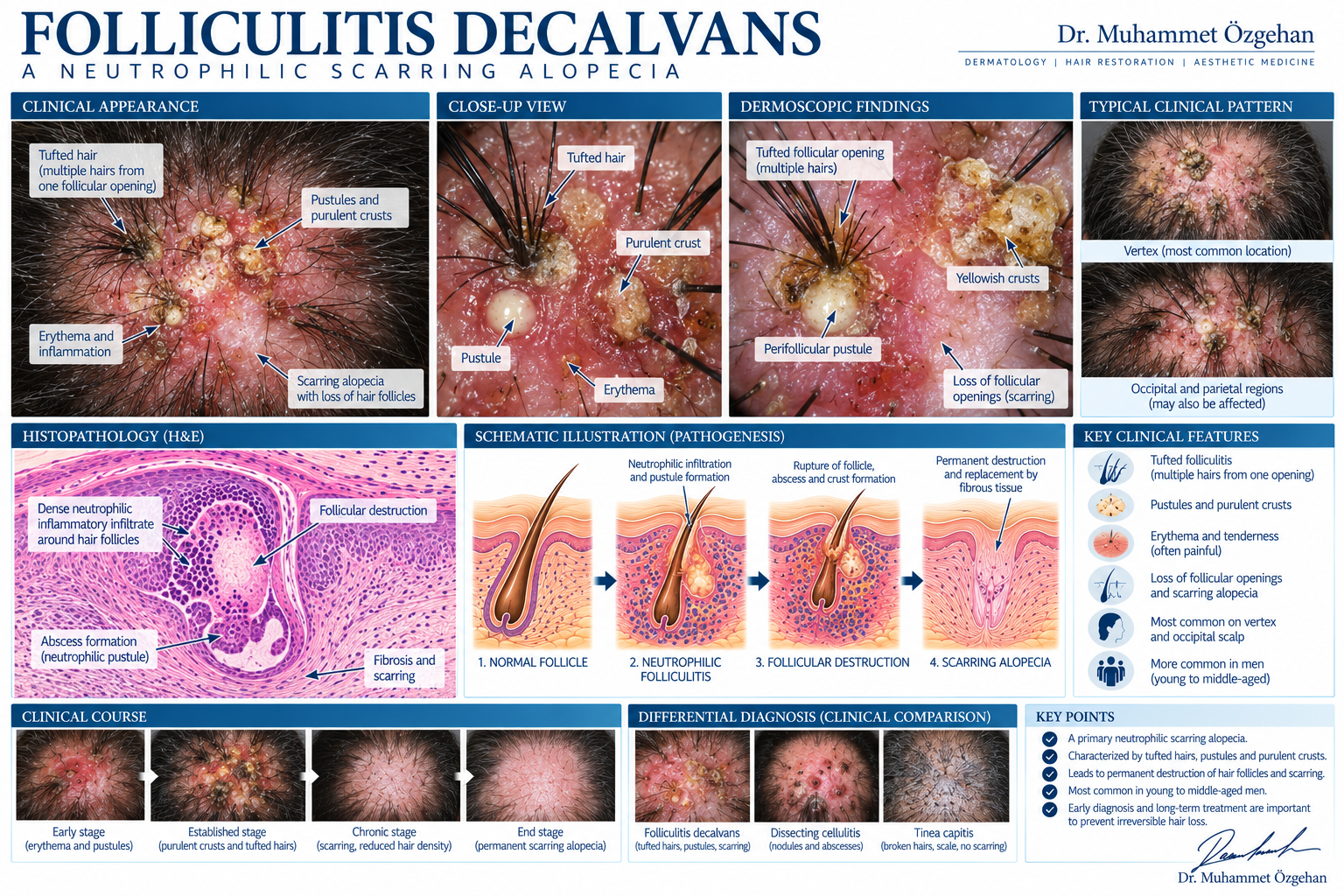
Folliculitis Decalvans Cicatricial Alopecia Clinical and Medical Illustration

📌 Patient Information Section: What Does This Condition Mean?

Neutrophilic cicatricial alopecias are severe hair diseases where neutrophils intensely invade and inflame hair follicles, leading to purulent discharge and ultimately permanent baldness (scarring).

  • Folliculitis Decalvans: Characterized by a "tufted hair" appearance. It causes inflamed papules and areas of permanent hair loss.
  • Dissecting Cellulitis: A condition seen in young men, characterized by interconnected deep abscesses, cystic swellings, and foul-smelling purulent discharge.

🩺 Clinical & Medical Guide for Physicians

  • Clinical Criteria: Pustules, erosions, crusts, and tufted folliculitis. In dissecting cellulitis, sinus tracts and fluctuating inflammatory nodules.
  • Histopathological Diagnosis (Punch / Excisional Biopsy):
    • Technique: 4 mm - 6 mm punch biopsy from the active lesion border (swab for culture separately). Material should be examined in transverse and vertical sections.
    • Pathology: Dense neutrophilic infiltrate (abscess formations), follicular rupture, foreign body giant cells, and advanced fibrosis.
  • Treatment Protocols: Long-term combined oral antibiotics (Rifampicin + Clindamycin), dapsone. Oral retinoids (isotretinoin) in resistant cases. Additionally, specialized and treatment approaches can be reviewed for clinical and surgical evaluations.

Scientific References and Bibliography

  • Otberg N, Kang H, Alzolibani AA, Shapiro J. Folliculitis decalvans. Dermatol Ther. 2008 Jul-Aug;21(4):238-44. doi: 10.1111/j.1529-8019.2008.00204.x. PMID: 18715292. PubMed Link
  • Rambhia PH, Conic RRZ, Murad A, Atanaskova-Mesinkovska N, Piliang M, Bergfeld W. Updates in therapeutics for folliculitis decalvans: A systematic review with evidence-based analysis. J Am Acad Dermatol. 2019 Mar;80(3):794-801.e1. doi: 10.1016/j.jaad.2018.07.050. Epub 2018 Aug 6. PMID: 30092322; PMCID: PMC6363910. PubMed Link
  • Waśkiel-Burnat A, Starace M, Iorizzo M, Katoulis A, Apalla Z, Asfour L, Freites-Martinez A, Ioannides D, Seyed Jafari SM, Kelati A, Pampaloni F, Piraccini BM, Rakowska A, Sechi A, Takwale A, Therianou A, Rudnicka L. Management of folliculitis decalvans: The EADV task force on hair diseases position statement. J Eur Acad Dermatol Venereol. 2025 Aug;39(8):1385-1394. doi: 10.1111/jdv.20687. Epub 2025 Apr 14. PMID: 40230058. PubMed Link
  • Alessandrini AM, Rossi AN, Dika E. Folliculitis Decalvans Due to Epidermal Growth Factor Inhibitor. Dermatol Pract Concept. 2024 Jul 1;14(3):e2024161. doi: 10.5826/dpc.1403a161. PMID: 39122496; PMCID: PMC11314079. PubMed Link

Folliculitis Decalvans and Scarring Hair Loss Frequently Asked Questions

What you need to know about the causes of Folliculitis Decalvans, scarring alopecia processes, and treatment approaches, with the expertise of Dr. Muhammet Özgehan's Clinic.

Folliculitis decalvans is a rare and progressive type of scarring (cicatricial) alopecia that leads to chronic inflammation, pustules (pus-filled bumps), and eventually permanent scarring hair loss on the scalp. It is often associated with an abnormal immune response triggered by the bacterium Staphylococcus aureus. Dr. Muhammet Özgehan states that stopping this condition in its early stages is critical for saving the follicles.

Yes, as the disease progresses, hair follicles are irreversibly destroyed and replaced by connective tissue (scar). This results in "tufted folliculitis" (a brush-like appearance where multiple hair strands emerge from a single follicular opening) and permanent baldness. Dr. Muhammet Özgehan emphasizes that if active infection and inflammatory flares are not controlled, hair will not regrow spontaneously in the affected areas.

The aim of treatment is to reduce bacterial load, suppress the immune response, and control the inflammatory process. The current approaches applied at Dr. Muhammet Özgehan's Clinic include:

  • Combined Antibiotic and Antiseptic Protocols: Long-term oral and topical antibiotic treatments under physician supervision.
  • Inflammation-Suppressing Applications: Special medical solutions and corticosteroid-derived supports to stop inflammation and itching.
  • Clinical Follow-up and Remission Management: Regular dermatological check-ups to minimize disease flare-up periods.

Hair transplantation is absolutely not possible in the presence of active inflammation, pustules, or infection. Surgery is not recommended unless the disease has been completely quiescent (in remission) for many years and the scar tissue has stabilized. Dr. Muhammet Özgehan states that even in very specific and calm cases, the graft survival rate in scarred tissue can be risky, and therefore, the priority is always to preserve existing health.

Managing chronic processes requires patience. Dr. Muhammet Özgehan offers the following recommendations to his patients:

  • Avoid harsh scratching and chemical products that may irritate the scalp.
  • Consistently follow the antibacterial shampoo and care protocols prescribed by the clinic.
  • Consult a physician without delay if new redness or pus-filled bumps are noticed.

For Your Questions and Clinic Appointment

For any questions you may have about folliculitis decalvans, scarring hair loss, and treatment planning, or to schedule a personal examination appointment, you can contact Dr. Muhammet Özgehan's Clinic immediately.