Medical Hair Encyclopedia
Dermatological pathologies and evidence-based clinical guidelines at international standards.
Androgenetic Alopecia (Male and Female Pattern Hair Loss)
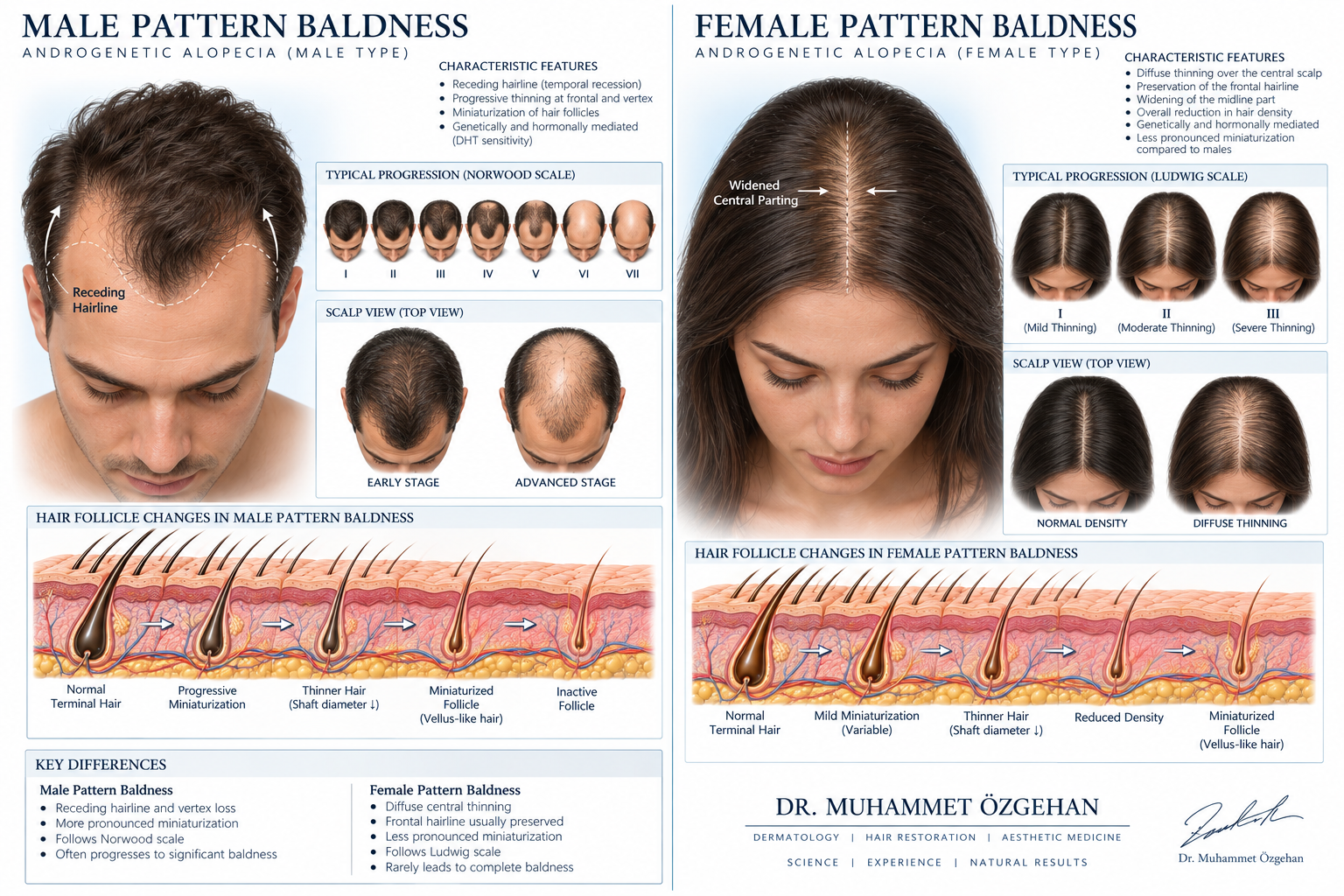
Prepared by: Dr. Muhammet Özgehan | Turkish Hair and Scalp Diseases Association
This guide has been compiled by Dr. Muhammet Özgehan in light of current literature.

📌 Patient Information Section: What Does This Condition Mean?
Androgenetic alopecia, commonly known as male pattern hair loss (or genetic hair thinning in women), is the most common type of chronic hair loss, caused by genetic predisposition and the influence of androgen (male) hormones. It is not a contagious or temporary condition; it is a lifelong process that needs to be managed.
- Appearance in Men: It manifests as recession in the temporal regions, a receding hairline, and thinning in the crown (vertex) region.
- Appearance in Women: Unlike complete baldness seen in men, it is observed as a general thinning of the hair, loss of volume, and widening of the part line in the crown of the head.
- What to Do?: Instead of unproven herbal products found online, consulting a specialist doctor as soon as hair loss begins is the most critical step in preserving existing hair.
🩺 Clinical & Medical Guide for Physicians
- Etiology and Mechanism: The conversion of testosterone to DHT (dihydrotestosterone) via the 5-alpha reductase enzyme, and the shortening of the anagen phase in genetically susceptible follicles, leads to miniaturization (shrinking of the roots).
- Diagnostic Criteria: Family history in anamnesis. On dermoscopy (trichoscopy), hair caliber variability (anisotrichosis > 20%), a decrease in the average number of hairs per follicular unit, and perifollicular brown halos.
- Current Treatment Protocols:
- Topical: 2% and 5% Minoxidil solution/foam (FDA-approved primary agent).
- Systemic: 5-alpha reductase inhibitors in male patients (under physician supervision).
- Procedural: Supporting follicular nutrition with PRP and Mesotherapy; hair transplant surgery as a surgical option in advanced cases.
Scientific References and Bibliography
- Chen S, Li L, Ding W, Zhu Y, Zhou N. Androgenetic Alopecia: An Update on Pathogenesis and Pharmacological Treatment. Drug Des Devel Ther. 2025 Aug 25;19:7349-7363. doi: 10.2147/DDDT.S542000. PMID: 40873858; PMCID: PMC12380480. PubMed Link
- Nestor MS, Ablon G, Gade A, Han H, Fischer DL. Treatment options for androgenetic alopecia: Efficacy, side effects, compliance, financial considerations, and ethics. J Cosmet Dermatol. 2021 Dec;20(12):3759-3781. doi: 10.1111/jocd.14537. Epub 2021 Nov 6. PMID: 34741573; PMCID: PMC9298335. PubMed Link
- Lolli F, Pallotti F, Rossi A, Fortuna MC, Caro G, Lenzi A, Sansone A, Lombardo F. Androgenetic alopecia: a review. Endocrine. 2017 Jul;57(1):9-17. doi: 10.1007/s12020-017-1280-y. Epub 2017 Mar 28. PMID: 28349362. PubMed Link
Androgenetic Alopecia (Male Pattern Hair Loss) Frequently Asked Questions
Insights into genetic hair loss, anti-androgen treatments in women, Sapphire FUE/DHI surgery, and personalized planning, with the expertise of Dr. Muhammet Özgehan Clinic.
Androgenetic alopecia is a type of genetic hair loss that occurs when DHT (Dihydrotestosterone), a derivative of the male hormone, gradually weakens and miniaturizes hair follicles in genetically predisposed individuals. Dr. Muhammet Özgehan states that this condition can affect both men and women, and early diagnosis is critical for preserving hair roots.
No, androgenetic alopecia is also frequently observed in women (female pattern hair loss). However, in women, it typically manifests as diffuse thinning in the crown and mid-scalp rather than complete baldness as seen in men. Dr. Muhammet Özgehan emphasizes that in women, this condition should be thoroughly investigated in conjunction with hormonal imbalances or iron/vitamin deficiencies.
In genetic hair loss, treatment and surgical planning are entirely personalized based on the patient's gender, stage of hair loss, and root quality. Current approaches applied at Dr. Muhammet Özgehan's clinic include:
- Personalized Treatment Planning: A customized roadmap is created, combining medical and regenerative protocols (PRP, Mesotherapy), taking into account the patient's hair root analysis, age, rate of hair loss, and overall health profile.
- Anti-Androgen Treatments for Women: For genetic hair loss in women, targeted anti-androgen medical treatments and topical solutions are safely applied, accompanied by clinical examinations, to balance hormonal factors and improve hair quality.
- Sapphire FUE and DHI Hair Transplant Surgery: In advanced cases requiring surgical intervention, Sapphire FUE (micro-channel opening with special sapphire blades) and DHI (shaveless/direct implantation with Choi implanter pen) techniques are meticulously applied to achieve the highest survival rate for grafts taken from the donor area, adhering to natural hairline and angle principles.
Androgenetic alopecia is the most common primary indication for hair transplant operations. Roots from the nape area (donor area), which are genetically resistant to hair loss and unaffected by the condition, can be safely harvested and transplanted to balding areas. Dr. Muhammet Özgehan personally plans the most appropriate surgical method according to the patient's age and degree of hair loss (Norwood scale).
While genetic predisposition cannot be entirely eliminated, the hair loss process can be significantly slowed down and controlled with appropriate medical protocols, anti-androgen approaches, and regular clinical follow-up. Dr. Muhammet Özgehan aims to preserve existing hair density for many years by offering personalized protective treatment plans to his patients.
Androgenetic Alopecia and Hair Loss Guide
A detailed video series presented by Dr. Muhammet Özgehan on the causes of hair loss, genetic factors, and modern treatment approaches.
Causes of Hair Loss and Genetic Factors
A comprehensive review of the basic mechanism of androgenetic alopecia, the DHT hormone, and the hair cycle.
Hair Loss in Women and Treatment Methods
Ludwig and Christmas Tree classifications, hormonal factors, and DHI hair transplantation solutions.
Female Pattern Hair Loss & Effective Treatments
International clinical perspective on female hair loss diagnostics, medical treatments, and unshavers DHI.
Get Expert Support for Your Hair Analysis
Contact our clinic for your personalized hair loss type and root analysis.