


Medical Hair Encyclopedia
Dermatological pathologies and evidence-based clinical guidelines at international standards.
CLINICAL GUIDELINE & PATHOLOGY
Scalp Involvement in Leprosy (Hansen's Disease) and Granulomatous Diseases – Diagnosis and Treatment Guide
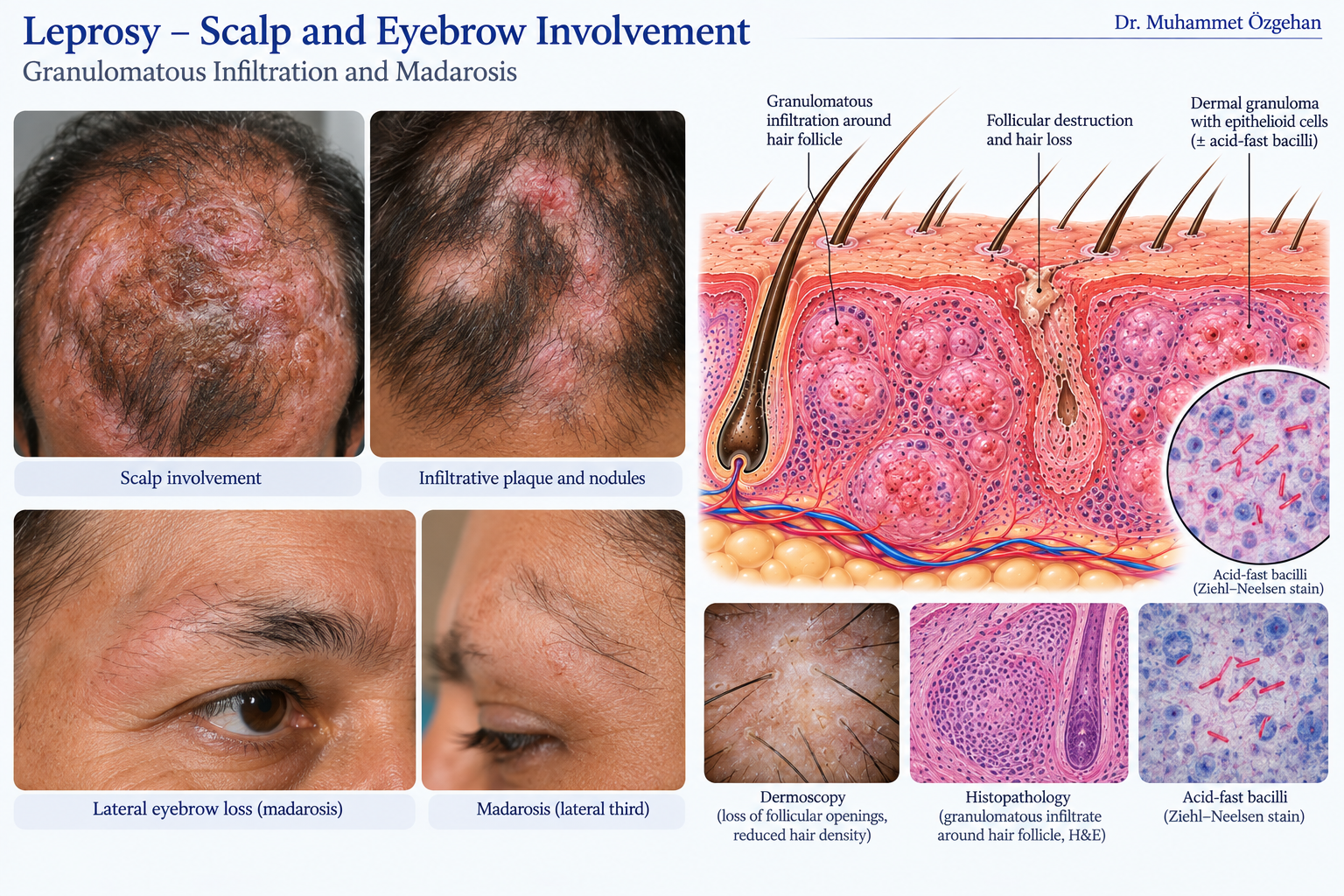
📌 Patient Information Section: What Does This Condition Mean?
Leprosy (Hansen's disease) is a chronic granulomatous infectious disease caused by the bacterium Mycobacterium leprae, affecting peripheral nerves and the skin. Although rare, it can lead to characteristic hair loss on the scalp and face.
- Hair and Eyebrow Involvement: Especially in the lepromatous form of leprosy, madarosis (loss of the outer portion of the eyebrows) and permanent hair loss with granulomatous nodules and plaques on the scalp can develop.
- Other Findings: Sensory loss in the skin (pale patches where hot-cold and pain sensations are lost), thickening of the earlobe, nerve involvement, and asymmetric facial findings.
- What to Do?: It is a disease that can be completely treated with multidrug combinations (MDT - Multidrug therapy). Early diagnosis is vital to prevent permanent nerve damage.
🩺 Clinical & Medical Guide for Physicians
- Etiology and Pathophysiology: Mycobacterium leprae or Mycobacterium lepromatosis are the causative agents. Bacilli prefer cooler body regions (earlobes, nasal mucosa, periphery of the scalp). They infiltrate hair follicles and nerve endings with granulomatous inflammation, causing cicatricial or non-cicatricial alopecias.
- Diagnostic Criteria and Clinical Findings: Loss of the lateral one-third of the eyebrows (Madarosis), infiltrative lesions, nodules, and sensory-deficient lesions on the scalp. Thickening of the great auricular nerve.
- Histopathological Diagnosis (Punch Biopsy):
- Biopsy Indication: A 4 mm punch biopsy is taken from suspicious granulomatous scalp or facial lesions.
- Pathology: Granulomas composed of epithelioid cells, Virchow cells (foamy macrophages), and lymphocytes in the dermis. Demonstration of intracellular bacillary clusters (globi) with Fite-Faraco or Ziehl-Neelsen staining.
- Current Treatment Protocols:
- Multidrug Therapy (MDT): Combinations of Rifampicin, Dapsone, and Clofazimine are administered continuously (for 6 months to 2 years depending on the disease type) in accordance with the World Health Organization (WHO) protocol. Additionally, specialized and treatment approaches can be reviewed for clinical and surgical evaluations.
Scientific References and Bibliography
- Kaya D, Garnes ND, Robins A, Su SY, Ginsberg LE, Chen MM. Leprosy of the great auricular nerve: case report and review of the literature. Clin Imaging. 2022 Feb;82:63-66. doi: 10.1016/j.clinimag.2021.10.001. Epub 2021 Oct 15. PMID: 34775253. PubMed Link
- Concha R M, Cossio T ML, Salazar S I, Fich S F, Pérez C C, González B S. Enfermedad de Hansen: Revisión a propósito de un caso [Hansen's disease: case report and review of literature]. Rev Chilena Infectol. 2008 Feb;25(1):64-9. Spanish. PMID: 18273528. PubMed Link
- Thaipisuttikul Y, Kateruttanakul P. Sarcoidosis mimics lepromatous leprosy: a case report. J Med Assoc Thai. 2007 Jan;90(1):171-4. PMID: 17621750. PubMed Link