


Medical Hair Encyclopedia
Dermatological pathologies and evidence-based clinical guidelines at international standards.
Medical Treatments (Pharmacological and Topical Solutions) – Clinical Management Guide
📌 Patient Information Section: What Do Medical Treatments Entail?
Hair loss or a decrease in hair quality does not always necessitate surgical operations like hair transplantation. Medical treatments, applied in the early and middle stages of miniaturization (shrinking) when hair follicles have not yet completely lost their vitality, are the most fundamental methods for preserving hair and stopping hair loss.
- In Which Cases Are They Applied?: They are preferred in the early stages of male-pattern (Androgenetic Alopecia) or female-pattern (FPHL) hair loss, in cases of telogen effluvium (widespread shedding), and to improve the quality of hair strands.
- How Do They Work?: They increase capillary blood flow to the hair follicles, support follicle nourishment, and alleviate the negative pressure of hormones responsible for hair loss (e.g., DHT) on the follicles.
- When Are Results Achieved?: Due to the slow biological nature of the hair cycle, the first noticeable improvements and reduction in hair loss with medical treatments are generally observed between 3 to 6 months.
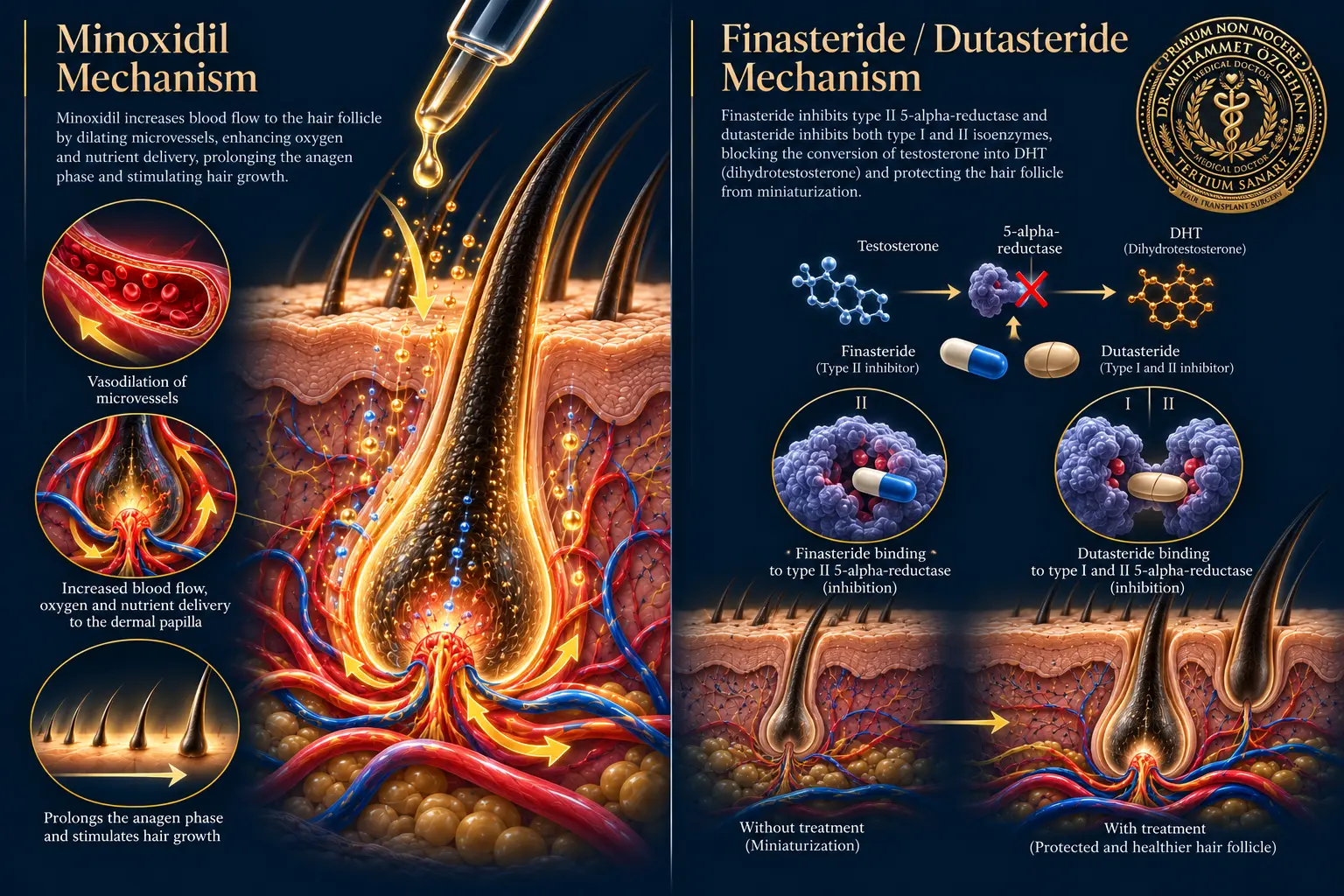
Figure 1: Minoxidil's effect of increasing vascular microcirculation, and the mechanisms of action of Finasteride and Dutasteride through 5-alpha reductase enzyme blockade and DHT reduction.
🩺 Clinical & Medical Guide for Physicians
- Etiology and Pharmacological Approach: Targeting androgenic and vascular factors involved in hair follicle miniaturization. Supporting follicular cell proliferation.
- Topical and Systemic Agents:
- Minoxidil (2% and 5%): Topical and low-dose oral formulations that prolong the anagen phase and increase hair shaft diameter by enhancing vascular endothelial growth factor (VEGF) release.
- 5-Alpha Reductase Inhibitors: Systemic agents (finasteride/dutasteride) that suppress the conversion of testosterone to dihydrotestosterone (DHT) in male-pattern hair loss.
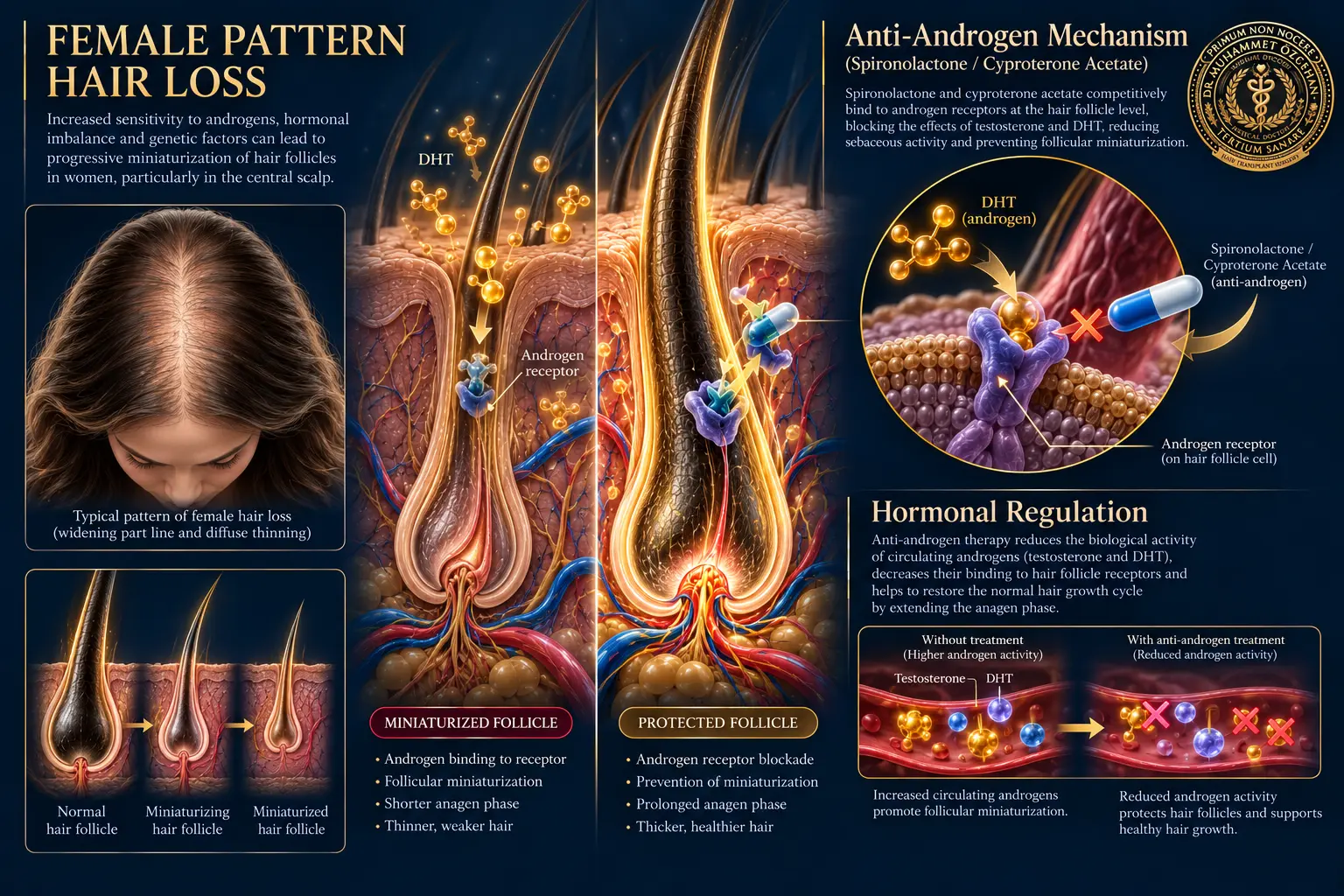
Figure 2: Antiandrogen agents such as spironolactone and cyproterone acetate in female-pattern hair loss, showing their pathways of follicular receptor blockade and hormonal regulation.
- Antiandrogens (For Female Patients): Management of agents such as spironolactone, cyproterone acetate, or flutamide in female patients with signs of hyperandrogenism (acne, hirsutism, etc.) through androgen receptor blockade and ovarian/adrenal androgen suppression.
- Clinical Follow-up and Combination Management: Optimization of single pharmacological agents according to the patient's etiological profile. Periodic monitoring of hair diameter and density measurements with digital trichoscopy. Additionally, expertise and treatment approaches can be reviewed for clinical and surgical evaluations.
Scientific References and Bibliography
- Gupta AK, Talukder M, Williams G. Comparison of oral minoxidil, finasteride, and dutasteride for treating androgenetic alopecia. J Dermatolog Treat. 2022 Nov;33(7):2946-2962. doi: 10.1080/09546634.2022.2109567. Epub 2022 Aug 15. PMID: 35920739. PubMed Link
- Gupta AK, Talukder M, Shemer A. Efficacy and safety of low-dose oral minoxidil in the management of androgenetic alopecia. Expert Opin Pharmacother. 2024 Feb;25(2):139-147. doi: 10.1080/14656566.2024.2314087. Epub 2024 Feb 6. PMID: 38315101.
- Seyed Jafari SM, Heidemeyer K, Hunger RE, de Viragh PA. Safety of Antiandrogens for the Treatment of Female Androgenetic Alopecia with Respect to Gynecologic Malignancies. J Clin Med. 2024 May 23;13(11):3052. doi: 10.3390/jcm13113052. PMID: 38892763; PMCID: PMC11172682. PubMed Link
- Arif T, Dorjay K, Adil M, Sami M. Dutasteride in Androgenetic Alopecia: An Update. Curr Clin Pharmacol. 2017;12(1):31-35. doi: 10.2174/1574884712666170310111125. PMID: 28294070. PubMed Link
- Motofei IG, Rowland DL, Baconi DL, et al. Androgenetic alopecia; drug safety and therapeutic strategies. Expert Opin Drug Saf. 2018 Apr;17(4):407-412. doi: 10.1080/14740338.2018.1430765. PMID: 29363345. PubMed Link
- Varothai S, Shapiro MY. Edema and accelerated hair growth. J Am Acad Dermatol. 2013;69(3):331-340.